


Simulation-based team training (SBTT) is widely used to strengthen collaborative clinical work, yet departments vary in the extent to which SBTT becomes part of everyday practice. Existing studies describe enabling organisational conditions, but there is less insight into how simulation is handled in daily work. This study examined departments where SBTT appeared to gain a stronger foothold during a region-wide initiative. We aimed to understand the local work through which simulation became part of departmental practice in these departments.
An interview study was conducted in four paediatric departments in Denmark during a region-wide, one-year SBTT initiative. Relative to the wider project data, two departments were characterised by a marked increase in registered simulation activity, while two showed larger improvements in selected dimensions of patient safety culture. These patterns were used as distinct positive deviance entry points for qualitative inquiry rather than as evidence of success in themselves. Eighteen staff were interviewed, including clinicians participating in sessions, local facilitators, managers and simulation programme leads. Data were analysed thematically using Braun and Clarke’s reflexive approach.
Analysis showed how SBTT became workable through ongoing organisational adjustment. Simulation activity stabilised when responsibility for coordination was explicit and when small openings in daily schedules were created for preparation and delivery. Regular participation also gave staff opportunities to speak with one another in ways that differed from everyday clinical interaction. Participants described how these encounters influenced communication and reflection in routine work. Staff also linked SBTT to greater continuity in how demanding situations were approached, particularly when events were high-stakes or disrupted routine work.
SBTT appeared to gain a stable place when staff and managers repeatedly adjusted simulation to local clinical pressures. Continued engagement was supported by practical organisational work and by staff recognising simulation as relevant to the situations they encountered in practice. Rather than pointing to a fixed model for implementation, the findings suggest that SBTT may acquire significance beyond the scenario room when departments keep making simulation workable. These insights may help departments examine the local conditions that allow SBTT to become part of routine practice.
What this study adds
•Simulation-based team training (SBTT) may become embedded when departments organise it alongside everyday clinical activity instead of treating it as a separate educational exercise.
•Small changes in timing or task distribution can help keep simulation feasible when clinical demands shift.
•Repeated simulation can make it easier for staff to speak differently with one another during difficult clinical work.
•Staff associate SBTT with more familiar and coordinated ways of approaching demanding situations, when scenarios are perceived as clinically plausible.
•Sustained SBTT depends less on a fixed implementation model than on continued local work that protects simulation when clinical pressure changes.
Simulation-based team training (SBTT) is widely used to help clinical teams practise collaboration and communication in patient care [1–3]. When used regularly, SBTT can help teams respond with greater steadiness during critical events and in routine work [3,4]. Yet this potential is not always realised. Many departments struggle to move beyond occasional sessions, and simulation often loses momentum when clinical pressure increases or when the activity depends on a few committed people [1,3,5]. Variation in whether SBTT is sustained raises a practical question: how does SBTT become something departments can maintain as part of everyday work?
Existing research suggests that SBTT can influence departmental culture [6–8]. Sustainability depends partly on how departments organise simulation within everyday clinical work, including who coordinates sessions and whether time can be protected under clinical pressure [9–11]. Simulation is also shaped by movement between the training setting and clinical practice. Research on translational simulation has shown a two-way relationship, in which staff bring experiences from simulation into clinical work, while existing routines and working relationships shape what simulation can address [12]. Taken together, this literature suggests that SBTT should not be understood as a self-contained educational activity [13], but as a practice that both responds to and gradually reshapes the routines and relationships of clinical care.
Implementation research offers a useful lens for understanding this process. Rather than viewing interventions as stable packages that move predictably from rollout to routine, implementation research draws attention to the local adjustments through which interventions are kept workable [14,15]. Staff judge whether SBTT feels relevant and adapt simulation activities to fit local circumstances. Such adjustments may influence whether simulation becomes part of daily work or remains a marginal activity [8].
What remains less clear is what staff and managers do as SBTT is fitted into everyday work. Although organisational and relational influences are widely acknowledged [10,16], we know less about how SBTT is handled over time and how repeated participation shapes everyday clinical practice beyond the simulation itself [17,18]. Staff may have to reorganise sessions or protect time as they try to make simulation possible under clinical pressure [17]. Practical adjustments of this kind are often less visible in studies that focus on broad enabling conditions. Yet practical adjustments seem important for understanding why SBTT becomes stable in some settings while remaining fragile in others [19].
The present study explores departments that stood out in a region-wide SBTT initiative because they had high registered simulation activity or showed improvement in selected patient safety culture dimensions. Paediatric departments are a relevant setting for this question. Acute deterioration and resuscitation are not everyday events, but when they occur, staff need to act together under pressure. Simulation has to prepare teams for this kind of work while still fitting into ordinary clinical days. By studying the selected departments, we aimed to understand the local work through which simulation became part of departmental practice.
The intervention took place in four paediatric departments in Denmark that participated in a 1-year SBTT intervention. The intervention aimed to increase the number of simulations conducted in departments by providing structured support for facilitators and dedicated time for simulation activity [20]. The four departments formed the intervention arm of a larger controlled study involving eight paediatric departments. The other four departments served as control departments. All four intervention departments were included in this qualitative study. All departments were already familiar with simulation, though they organised and prioritised it differently in everyday work.
We used positive deviance as a case-selection logic. The aim was to examine departments where SBTT appeared to gain a stronger foothold than the wider pattern observed during the intervention year [21,22]. Positive deviance starts from a simple premise: under broadly similar constraints, some groups find ways of working that others do not. The comparator was the variation observed across the wider project, where departments differed in registered simulation activity and change in patient safety culture. The four departments were therefore identified as positive deviance cases relative to wider project variation, not relative to one another. This use of positive deviance helped us identify cases where local practice warranted closer qualitative attention [21].
During the intervention year, all four departments routinely documented their simulation activities, and staff completed the Safety Attitudes Questionnaire (SAQ-DK), a validated questionnaire measuring staff perceptions of patient safety culture, immediately before and after the intervention [23,24]. These data were collected as part of the wider intervention study and provided a useful means of observing variation in how SBTT was implemented across departments [20].
We identified two empirical forms of positive deviance. Two departments showed significant improvements in selected patient safety culture dimensions, particularly perceptions of management and working conditions, as indicated by pre- and post-intervention SAQ-DK scores (Supplementary Material Appendix 1) [23]. Two departments conducted substantially more simulation sessions during the intervention year than the other intervention departments (Supplementary Material Appendix 1). We treated the first pattern as culture-improvement positive deviance. The culture-improvement pattern referred to staff perceptions of patient safety culture, not to direct measures of patient safety outcomes. The high-activity pattern referred to registered simulation activity, not to the quality or effect of individual sessions. We did not treat high simulation activity and culture improvement as interchangeable indicators. Instead, they were used as distinct empirical entry points into the same qualitative question: how SBTT became workable and meaningful in local departmental practice.
We treated these patterns as starting points for qualitative inquiry rather than as endpoints in themselves. In established positive deviance work, such outliers are identified through routinely collected data and then examined qualitatively to understand the local reasoning and organisational conditions that enabled success [21,22]. Following this logic, we focused on the four intervention departments and explored how staff made sense of SBTT. The study was explanatory in intent. Quantitative variation guided case selection, while the qualitative analysis examined how simulation gained a foothold in everyday departmental practice [25].
We approached data collection with the recognition that participants’ accounts of SBTT would be shaped by their roles and experiences within their departments. Using a purposive sampling strategy, we sought to include staff whose everyday work placed them in different relations to simulation. Participants were invited by e-mail and chose to take part voluntarily. The 18 interviewees reflected this spread, including four staff members who participated in simulation sessions, seven local facilitators, three departmental managers and four simulation programme leads or local stakeholders with responsibility for simulation. These positions offered access to different aspects of SBTT’s implementation and allowed participants to speak from distinct points of view.
Two members of the research team (ALS and MLG), both familiar with simulation-based education, conducted all interviews either in person or online through Microsoft Teams. Conversations were semi-structured and designed to explore how SBTT had come to matter in each department. Questions invited participants to describe how the simulation was organised, how it fitted into clinical routines and how they experienced taking part in or facilitating sessions. The interview guide drew on work in contemporary simulation research that views simulation as something shaped within local contexts and through the interactions that unfold among the people involved [12,17,26]. The full interview guide is provided in Supplementary Material Appendix 2. It was piloted during the first interviews and refined to support open accounts and to allow participants to raise issues that lay outside the intervention’s original intentions.
Interviews were conducted in Danish, audio-recorded and transcribed verbatim before analysis. Analysing the material in the source language helped preserve participants’ phrasing and contextual nuance. Quotations used in the article were translated into English by the first author (ALS), checked by the second interviewer (MLG) for tone and finally reviewed for syntax by native English-speaking co-authors (EP and VB). Participants could withdraw at any point.
We analysed the material using Braun and Clarke’s reflexive approach to thematic analysis [27,28]. We developed themes through close and repeated engagement with the interview material. The process unfolded alongside data collection, with ongoing discussions between ALS and MLG helping us attend to early tensions and emerging lines of interest. ALS and RDJ carried out the initial coding. We worked through the transcripts in Danish, moving back and forth between close reading and broader impressions of how participants described SBTT in their departments. Codes were developed with reference to the study aim. We focused on how participants described the organisation of SBTT and the adjustments that kept simulation workable. We also attended to accounts of how simulation entered everyday interaction. During coding and theme development, we considered whether accounts differed between high-activity and culture-improvement departments. We did not treat the two groups as separate cohorts for subgroup comparison, because the study was not designed for that purpose. The distinction instead helped us work with the developing themes more carefully. As the themes took shape, we returned to material from both entry points and considered whether some parts of the analysis were mainly carried by one type of case. This helped us keep high activity and culture improvement analytically distinct, without turning them into subgroups for comparison.
Theme development involved several rounds of discussion within the research team. These conversations focused less on achieving consensus and more on clarifying what each theme helped us understand. We also considered what each theme risked making less visible. Analysis continued until we judged that the material offered sufficient depth to address the study aim [29]. NVivo 15 was used to organise transcripts and keep track of coded material.
The study was carried out by a team with longstanding involvement in simulation-based education and clinical practice. ALS is a medical education researcher whose work focuses on simulation-based education and the evaluation of educational interventions in healthcare. MLG is trained in psychology and works with adult learning and expertise development, including simulation as a situated practice. RDJ contributes experience from medical education research with a focus on simulation across clinical settings. ML brings a clinical background in paediatrics and neonatology, alongside experience from conducting simulations and simulation faculty teaching. EP and VB draw on emergency medicine and research on organisational culture, team performance and simulation integration.
The study was registered with the Regional Ethics Committee (no. 1-16-02-232-22) and the General Data Protection Regulation at Aarhus University (no. 2016-051-000001). All participants provided informed written consent and we have adhered to the COREQ (Consolidated Criteria for Reporting Qualitative Research) guidelines. The checklist is provided in Supplementary Material Appendix 3.
Our analysis constructed three themes that illuminate how SBTT took hold in these departments and how staff came to understand its value. Sustaining engagement through planning and management examines the organisational work required to keep simulation viable amid everyday clinical demands. Cultural integration through psychological safety and team learning explores how SBTT affected relationships in routine work. Professional growth and well-being through simulation considers how participation shaped staff confidence and their connection to the workplace. Although the themes are related, each theme addresses a distinct part of the process. The first theme focuses on how simulation was kept possible. The other themes examine how repeated participation shaped interaction and how staff described simulation as affecting their ability to manage demanding work. The themes were developed across the four positive deviance cases. We used the two entry points to guide case selection, not to divide the material into two comparative groups. The same broad processes appeared across both entry points, although with different emphases. Participants from high-activity departments tended to describe the practical work of organising sessions in greater detail. Participants from culture-improvement departments more often linked SBTT to everyday interaction and managerial support. We therefore read the themes as cross-case processes, not as findings that apply identically to each department. Patient safety culture improvement was part of the case-selection logic, not a separate outcome explained through the thematic analysis. Across interviews, accounts sometimes pulled in different directions, revealing both the enabling conditions that supported SBTT and the tensions that accompanied its integration. Below, we present each theme and illustrate how staff described the work of making simulation a durable part of everyday departmental practice.
Across departments, staff portrayed SBTT not as something that naturally persisted, but as something that required continuous prioritisation and adjustment to the rhythms and constraints of clinical work. Early on, efforts often depended on individual enthusiasm; when staffing pressures rose, or priorities shifted, simulation activity quickly stalled. What made a difference over time was the gradual recognition that SBTT needed to be organised and protected like other important departmental work. In participants’ accounts, sustainability was therefore not a feature of the simulation programme alone. Sustainability was produced through recurring local decisions that made participation possible without making clinical work feel less manageable.
Managers and simulation programme leaders described how this recognition translated into concrete organisational work. Roster adjustments and protected preparation time were mentioned repeatedly as mechanisms that made simulation feasible. As one programme leader noted, ‘We close clinic slots and adjust staffing to make sure training happens… if I didn’t allocate a day a month for the facilitators, it simply wouldn’t happen’ (P5). Such adjustments were modest, but they signalled that simulation belonged within the department’s operational structure.
Not all participants experienced this added structure as a relief. A few described simulation as an additional layer of coordination in an already busy clinical setting. As one programme leader and facilitator noted, simulation required deliberate staffing decisions to be feasible: ‘If you don’t acknowledge its importance and, for example, don’t call in enough staff – because there need to be some who are training and others who are maintaining day-to-day operations – then it simply isn’t possible’ (P3). Especially when participants were irritated or described colleagues trying to avoid sessions, they recognised that simulation rarely happened without clear planning. This points to a recurring tension in the data: making simulation more formal helped it continue alongside everyday clinical work, but it also changed how staff took part, moving from informal arrangements to more scheduled and organised participation.
As routines stabilised, departments found room to adapt SBTT to local conditions. Several interviewees described a shift from half-day sessions towards shorter simulations woven into quieter clinical moments. ‘Instead of waiting for a free afternoon, we started running smaller sessions in between tasks. That made it easier for people to join’ (P10). These adjustments were driven less by a desire to innovate and more by a need to keep simulation functioning amid unpredictable workloads.
Leadership visibility played an important role. When managers occasionally joined sessions, staff appeared to read this as a signal that SBTT mattered for the whole department. A facilitator reflected: ‘When our leaders join a few times a year, it changes how people see it. It becomes something for the whole department, not just for juniors’ (P14). Their participation mattered less for the content of the scenario and more for what it communicated about departmental priorities.
Taken together, these accounts show that sustaining SBTT was not a linear progression but an ongoing negotiation. Departments had to make simulation structured enough to continue, while keeping it flexible enough to survive clinical pressure. SBTT endured because staff and management worked to keep it sustainable in everyday practice, with leadership involvement expressed less through directive control than through ongoing organisational support and visible participation.
Across departments, participants described how SBTT gradually reshaped the way they related to one another in daily work. This was not a straightforward cultural shift. Some changes emerged quietly through repeated participation; others surfaced only when people tried to articulate what felt different after simulation had become routine. Our analysis does not suggest that simulation removed hierarchy. Nor does it suggest that psychological safety simply followed from participation. Rather, participants described simulation as a recurring setting where staff could try different ways of speaking before similar moments arose in clinical work. In this theme, psychological safety refers to participants’ descriptions of becoming more able to voice concerns and discuss difficult events without expecting blame.
Several staff members emphasised that simulation provided a setting in which familiar hierarchies loosened. A scenario could invert normal dynamics: a junior nurse guiding an experienced physician or a facilitator pausing the action to draw attention to a missed cue. One participant reflected, ‘During simulation, roles shift. A younger nurse might guide a senior doctor… it changes how we interact in real situations’ (P10). These moments did not eliminate hierarchy, but they made it easier for staff to raise concerns during clinical work. We use this quote to illustrate the theme’s central point: repeated simulation gave staff a setting in which altered forms of interaction could be practised before similar interactions were needed in clinical care.
Not all participants found this role flexibility comfortable. A few described early sessions as unsettling, particularly when senior staff struggled in front of others. One facilitator recalled that this discomfort initially led to hesitation, as some colleagues worried that the simulation exposed their vulnerabilities rather than supporting learning. As this facilitator put it, ‘Some people avoided it because they were afraid of being judged. It took time for them to realise that it wasn’t about proving themselves but about improving as a team’ (P14). Over time, repeated participation softened these concerns, and participants described a shift from feeling scrutinised to feeling collectively responsible for supporting team performance.
Participants highlighted that the cultural influence of SBTT extended beyond the training room. For some, simulation altered how they debriefed after real events. ‘We don’t just train in simulation. It has changed how we debrief after real cases. We are more open… more curious’ (P9). Staff described becoming more willing to gather after challenging situations and to examine what had taken place without treating missteps as individual shortcomings.
This also changed how some participants described the tone after difficult events. Shared simulation experiences seemed to make uncertainty more recognisable as part of clinical work, rather than as an individual shortcoming. As one participant put it, ‘There’s also a kind of care for each other – more than a judging attitude’ (P8), adding that when someone expressed uncertainty during simulation, the response was often ‘I know that feeling’.
The dual purpose of simulation, as both a developmental activity and a potential evaluative tool, remained a source of tension. Several participants described early sessions as exposing. One participant said, ‘In the beginning, it felt like going to an exam… but the last times it’s been more like, “this is great that we get to practice this”. I’ve gone from feeling it was an exam to now it’s just fine’ (P7). We read this as a shift in how simulation was understood. It was still visible work in front of colleagues, but over time it became easier to treat that visibility as part of learning rather than as assessment. These concerns did not disappear entirely but became easier to navigate as the purpose of SBTT became clearer and as leaders consistently reinforced its developmental intent.
Participants’ accounts described simulation as a place where new relational habits could be explored in manageable steps. Rather than describing abrupt cultural change, participants spoke of shifts that unfolded as simulation became more familiar. Across the accounts, staff described becoming more able to speak up during clinical work and to discuss difficult events without treating uncertainty as individual failure. SBTT gained significance by giving teams repeated opportunities to reflect on how they worked together. As simulation became routine, these ways of relating gradually carried over into everyday clinical practice.
Participants often described SBTT as shaping how they handled uncertainty in everyday clinical work. This influence was linked to a growing sense of familiarity with challenging situations through repeated exposure in a controlled setting. As one facilitator put it, ‘When an emergency happens, training kicks in. Instead of panic, there’s a kind of calm’ (P14). Participants emphasised that this change did not occur all at once. One noted that development unfolded ‘over time’ and ‘step by step’ (P4). Our interpretation is cautious. Participants did not describe SBTT as making work easy. They described simulation as helping some staff experience rare or demanding situations as more recognisable.
Several interviewees linked this preparedness to feeling more anchored in their roles. They described a form of confidence that made demanding situations less draining and the workplace easier to stay in. One programme leader reflected, ‘People don’t leave as often. They feel more capable… fewer stress reactions, less sick leave’ (P14). We read such statements as participants’ interpretations of how simulation related to workforce strain. They are not evidence that SBTT alone explained changes in sick leave or retention. Not everyone framed the connection so directly, but many described how simulation helped them recognise what they could handle, which eased day-to-day pressures.
Simulation also created shared reference points for demanding situations. One participant captured this sentiment clearly: ‘It’s like being in an escape room together. You face a challenge, work through it, and come out with stronger connections. That’s invaluable in our daily work’ (P6). We read this account as part of staff members’ experience of facing difficult work with colleagues rather than carrying such situations alone.
Not all reflections were immediately positive. Some described initial scepticism, especially when simulation was introduced at a pace that felt misaligned with other pressures in the department. Others felt exposed the first few times they participated. These reactions softened for most, though not for all. A few interviewees noted that certain colleagues continued to keep a distance, joining sessions but avoiding deeper engagement. These quieter reservations served as reminders that SBTT did not produce uniform effects and that its influence depended on local working relationships and staff turnover.
Across accounts, SBTT emerged as a practice that supported staff in ways that were sometimes modest and sometimes deeply felt. Participants described how simulation helped them steady themselves in difficult moments and gave them a place to acknowledge uncertainty with colleagues. They framed these effects not as outcomes of a specific model of simulation, but as by-products of returning to the practice often enough for simulation to influence how they approached their work.
This study examined four paediatric departments that stood out within the wider variation observed in a shared regional SBTT initiative. Two departments registered substantially more simulation activity than the other sites. Two showed clearer improvement in selected dimensions of patient safety culture during the intervention year. We treated these patterns as empirical entry points. High activity did not, by itself, tell us how simulation had been organised locally. Improvement in patient safety culture did not, by itself, show that SBTT had changed departmental culture. For that reason, the two patterns shaped how cases entered the study, but they were not treated as separate explanatory groups. The qualitative analysis allowed us to examine how staff and managers made sense of simulation in these settings, and how SBTT was fitted into everyday departmental work. Across the four cases, participants described local work that helped simulation continue despite clinical pressure and helped staff recognise the activity as relevant to practice.
The analysis suggests that SBTT gained a foothold through practical work and local meaning-making. Staff and managers had to make simulation possible within ordinary clinical activity by protecting time and clarifying responsibility. Staff also had to come to see simulation as a credible way of preparing for situations that mattered in their own department. In this sense, simulation became sustainable not only because sessions were organised, but because staff increasingly understood the activity as relevant to their work. This distinction helps explain why sustainability was not simply a matter of activity volume. It depended on whether simulation was made possible in the schedule and meaningful in practice.
Earlier research shows that SBTT often fades when it is treated as an add-on to clinical work or when its organisation depends on short-term enthusiasm [1,3,5]. The accounts in this study point to a related, though more finely grained, pattern. Staff described sustainability as something that developed when simulation was folded into the ordinary operation of the department. Keeping SBTT alive required ongoing coordination, including small shifts in the day’s organisation and protected openings where facilitators could prepare or run sessions without destabilising clinical flow. These actions made simulation feel like part of the department’s everyday work rather than a separate activity. Managerial involvement therefore appeared less as endorsement from a distance and more as practical work that protected simulation from being displaced by immediate clinical pressures.
Across departments, simulation was described as both shaped by and shaping its organisational setting. This echoes recent arguments that simulation is not a fixed intervention but a cultural practice that evolves in relation to local relationships and constraints [12,19,30]. In another positive deviance study of sustained in situ simulation, continued activity was linked to the ongoing local organisational work required to keep simulation workable within everyday clinical constraints [31]. Our findings add a more practice-near account of what such work involved. Participants described changes that were most visible in specific moments of practice rather than as broad or explicit cultural shifts. Several described how conversations after difficult cases had become more open, often because colleagues were used to speaking together in the simulation room. Others noted that demanding moments in clinical work felt less disorienting when they had rehearsed similar situations with the same people. A few also reflected on role-related tensions during acute events, explaining that habits from simulation sometimes made it simpler to voice concerns or redirect attention when something was being missed. These changes did not replace existing cultural norms, but interacted with them. Several participants noted early hesitation, especially when colleagues feared being judged. Repeated exposure softened these concerns, but ambivalence remained. This nuance is important. Positive deviance can make successful settings appear unusually harmonious. Our findings suggest something more ordinary. SBTT became legitimate because departments found ways to make participation feel useful despite discomfort.
Staff also linked SBTT to a steadier sense of being able to handle demanding work, particularly in departments where critical events were rare but carried weight when they occurred. Earlier studies have associated simulation with confidence and emotional preparedness [19,32], and the accounts here follow a similar line. Quantitative findings from related work have shown that simulation initiatives can coincide with reductions in strain and improved work patterns, including lower sick leave rates [33,34]. The qualitative accounts in this study should not be read as evidence of a direct pathway from SBTT to reduced sick leave. Rather, the accounts show how staff made sense of simulation as a practice that could make demanding situations feel more familiar. What stood out, however, was how dependent this steadiness was on the simulation being experienced as credible and connected to local realities. When scenarios felt detached from actual clinical work, participants found it difficult to describe comparable benefits. This conditionality underscores that simulation does not produce uniform outcomes. Even in departments with strong engagement, its influence depended on whether staff recognised the scenarios as relevant to the situations they navigated in practice.
Taken together, these findings point to a broader way of understanding simulation within clinical systems. In our analysis, SBTT acquired meaning through repeated encounters. Staff returned to simulation over time, adapted the activity to local concerns and gradually changed what they expected from one another in difficult situations. The cultural and professional developments described by participants were not the result of a single intervention period but of ongoing interaction with a practice that settled slowly into the department’s routines. This aligns with arguments that simulation-based initiatives often sit between research and quality improvement activity, with their influence shaped by the organisational conditions in which they unfold [35].
This way of understanding SBTT has implications for implementation. Much of the SBTT literature treats elements such as managerial attention and workflow considerations as separate determinants [9,10]. Participants’ accounts suggest that staff did not experience these conditions separately. Management support and practical adaptation became intertwined in daily work. Shorter sessions kept simulation alive when longer formats were unrealistic. Sustainability, therefore, appeared less as a matter of assembling the right components and more as a matter of keeping simulation workable as clinical pressure changed. For departments trying to sustain SBTT, evidence-informed design is not enough on its own. Staff and managers also have to keep finding room for simulation in ordinary work. Staff have to recognise the scenarios as close enough to the clinical situations they find difficult.
While this study focused on Danish paediatric departments that had integrated SBTT in particularly stable ways, the findings offer insight into how similar initiatives might be supported elsewhere. Figure 1 summarises these implications. Rather than presenting transferable steps, the figure highlights questions that departments can ask of their own practice. Where is simulation protected in the working day? Do scenarios still feel close to the clinical situations that staff find difficult?

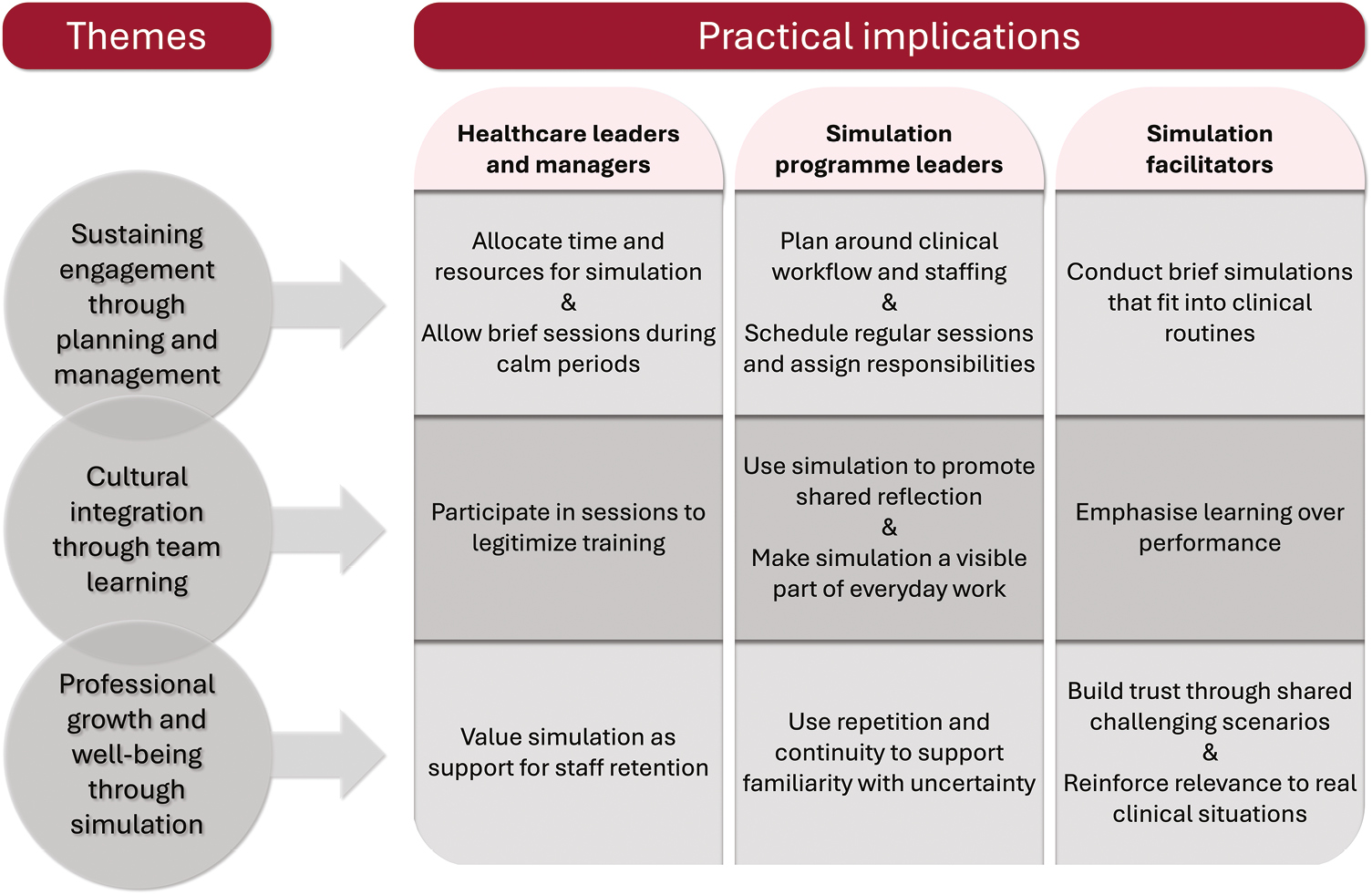
Practical implications for key actors across themes
Participants described leadership involvement as significant for keeping SBTT feasible. Small adjustments to staffing, short periods set aside for preparation and occasional participation in sessions signalled that simulation belonged within clinical duties rather than outside them. These actions helped maintain engagement and reduced concerns about hierarchy. Clear responsibility for SBTT coordination further supported continuity by ensuring that activity did not depend solely on individual motivation. Several participants linked this form of involvement to a stronger sense of security and professional belonging, suggesting that framing SBTT as part of workforce support can strengthen its position in the organisation. For leaders, the implication is not simply to endorse SBTT. Leaders need to make visible decisions that protect simulation when clinical pressure rises.
Programme leaders played a central role in shaping how SBTT was fitted to local clinical routines. They adapted the timing and scale of sessions, incorporated current clinical issues into scenarios, and put structures in place that helped facilitators manage their work. These adjustments supported a sense of relevance among staff and helped the simulation sit alongside other clinical demands. Programme leaders also contributed to shared reflection by drawing connections between what unfolded in SBTT and issues that resurfaced in daily clinical work. Making these links visible in meetings or handovers helped normalise SBTT as part of ongoing departmental development. For programme leaders, the task is not only to maintain activity levels. They also need to keep asking whether simulation reflects the work that staff recognise as difficult or consequential.
Facilitators shaped the learning environment in which colleagues engaged with SBTT. Their ability to create room for open conversation influenced whether the simulation was experienced as constructive rather than evaluative. Offering short sessions during quieter moments in the day helped maintain activity under time pressure. Several participants described how the relevance of the scenario and a sense of psychological safety worked together to support trust and confidence. For facilitators, psychological safety is situated work. Staff appeared more willing to engage when facilitators made the purpose of simulation clear and connected the scenario to recognisable clinical situations.
This study was guided by an interpretivist orientation, treating participants’ accounts as situated interpretations of their experiences with SBTT rather than as direct representations of its effects [36]. Our focus on departments where SBTT had gained momentum in different ways offered insight into how simulation became sustainable in those settings. We therefore read the findings as situated accounts of SBTT in paediatric departmental work, rather than as a comparison between paediatrics and other clinical specialties. Still, our positive deviance approach created an important boundary around the study. We identified the four departments through quantitative variation in simulation activity and patient safety culture within the wider project. We did not conduct parallel interviews in departments where SBTT remained intermittent or where patient safety culture did not improve. The comparator was therefore used for case identification, not to compare these departments qualitatively with departments where SBTT remained more fragile. Departments where SBTT implementation remained intermittent or fragile would likely have produced different accounts, and the findings should be read with this boundary in mind.
To help counteract such limitations, the research team included members with different forms of clinical and educational expertise. Several members brought experience from clinical practice and simulation-based education. Others contributed perspectives from psychology and educational research. These vantage points supported the interpretation of participants’ accounts by helping us notice how simulation was shaped by local organisational pressures and by concerns arising from everyday clinical and educational work. Our familiarity with simulation also shaped what we noticed and what we expected to find. We addressed this through regular discussions of how our assumptions might influence the questions we asked and the interpretations we developed, and we regard this ongoing reflexivity as an important element of the study’s credibility.
SBTT can contribute meaningfully to everyday clinical work, but its contribution depends on how local systems support it. In the departments we studied, simulation gained a stable presence when staff and managers found workable ways to fit it into daily clinical activity. These ways of working were not universal solutions. They were local responses to local pressures.
The accounts show that sustainable SBTT is less about following a predefined implementation or delivery model and more about the ongoing work of fitting simulation to local priorities and working relations. By exploring departments that had managed this alignment, the study offers insight into how simulation can acquire meaning beyond the scenario room and how it may contribute to professional confidence and a more coherent workplace culture. For other departments, the findings do not prescribe a single pathway. They suggest a more diagnostic way of approaching implementation: ask where simulation can be protected in the working day and whether scenarios remain close enough to local clinical realities to shape how people work together.
Supplementary data are available at Journal of Healthcare Simulation online.
None declared.
None declared.
None declared.
The study was registered with the Regional Ethics Committee (no. 1-16-02-232-22) and the General Data Protection Regulation at Aarhus University (no. 2016-051-000001), and all participants provided written informed consent.
None declared.
1.
2.
3.
4.
5.
6.
7.
8.
9.
10.
11.
12.
13.
14.
15.
16.
17.
18.
19.
20.
21.
22.
23.
24.
25.
26.
27.
28.
29.
30.
31.
32.
33.
34.
35.
36.
 Learning from positive deviance: a qualitative multisite study of simulation practice in paediatric departments
 Facebook
 Twitter
 Linkedin
 Whatsapp
