


Clinical debriefing is an established practice that facilitates experiential learning in the workplace to enhance team performance, systems learning and patient outcomes. Despite strong evidence, widespread adoption remains elusive and multiple barriers have been described. A key contributor is marked variation in terminology, which fosters divergent interpretations of the practice, obscures clarity of purpose and undermines uptake. This article argues for the adoption of ‘clinical debriefing’ as a unified umbrella term to promote shared understanding and support both routine and prompted reflection. Unified terminology enables consistent communication, strengthens safety culture and aligns with contemporary approaches to learning from everyday practice. It also improves the accessibility and comparability of research, and offers an opportunity to move away from language with negative emotional connotations. Establishing coherent terminology is a foundational step towards scaling clinical debriefing, advancing research and improving outcomes for healthcare teams and patients.
What this essay adds
•Explores how inconsistent language contributes to variable practice and undermines the widespread adoption of debriefing in clinical environments.
•Argues that unified terminology strengthens safety culture, positioning clinical debriefing as a tool for learning from both routine practice and specific clinical events.
•Advocates for ‘clinical debriefing’ as a unifying umbrella term to reduce conceptual fragmentation and promote shared understanding across healthcare settings.
•Highlights additional opportunities generated by this change, including a move away from terminology with negative emotional connotations and improved accessibility and comparability of research on clinical debriefing.
Debriefing is central to healthcare simulation, yet the language used to describe similar practices in clinical environments remains strikingly inconsistent. Simulation educators have led the development of debriefing theory, methods and faculty training and many of the structures now used to guide reflection at the bedside originate from simulation-based education [1–4]. However, as these practices migrate into ‘real-world’ clinical care, they are accompanied by a proliferation of overlapping terms – from ‘hot debriefings’ and ‘after action reviews’ to ‘post-code pauses’ – that obscure shared purpose and fragment the evidence base [5,6].
In this essay, we argue that simulation communities should actively champion ‘clinical debriefing’ as a unifying umbrella term for structured, facilitated reflection in clinical settings. Doing so is not merely a semantic exercise: coherent terminology strengthens the translational impact of simulation, supports faculty who work across simulated and clinical spaces and enables clearer research syntheses on how debriefing influences learning, team performance and patient safety. For readers of a healthcare simulation journal, the language of clinical debriefing is therefore a core concern, shaping how simulation-informed practices are recognised, adopted and evaluated beyond the simulation centre.
Debriefing in clinical environments is now an established practice. Structured group discussion offers an opportunity for guided reflection and exploration of clinical events, aiming to bridge the gap between experience and understanding and to enact positive change. Research demonstrates that clinical debriefing is a powerful facilitator of experiential learning [7], and positively influences the dynamics of teams and the well-being of individuals [8]. Moreover, clinical debriefing improves team performance [9], provides important input for systems and process improvement [10] and can improve patient outcomes [11,12]. Contemporary understanding of clinical debriefing largely derives from simulation-based education, where structured reflection is foundational to learning and development [1,4].
Despite this burgeoning evidence base, there is a lack of widespread uptake of clinical debriefing by healthcare teams. Efforts are now increasingly shifting towards optimising implementation and offsetting barriers [13]. This has included development of debriefing tools to address perceived skill gaps, and expanding the conversation around clinical debriefing culture [8,14]. Another key consideration is conceptual: uncertainty about what clinical debriefing actually is, what it is for and what outcomes it should achieve. For many working clinicians, this lack of clarity of purpose remains a significant barrier to the uptake of clinical debriefing [13].
Language is a crucial part of this conversation. As Murphy et al. noted: ‘words matter because they frame our understanding of the world around us and how we interact with each other in real life’ [15]. This is evident in recent discussions on how we describe non-technical skills [15], psychological safety [16] and simulated patients [17]. In simulation, shared terminology is a key enabler of consistent debriefing practice, supporting facilitator training, learner expectations and quality improvement [4]. In contrast, clinical environments use a wide array of terms for what is fundamentally the same structured reflective practice, as illustrated in Figure 1 [5,6,18–20]. We believe that this variation in terminology contributes to conceptual ambiguity, undermining attempts to scale clinical debriefing and weakening efforts to normalise structured reflection in everyday clinical work.
The engagement of healthcare staff is an essential step in the implementation of any initiative, and fundamentally relies on effective communication and shared understanding [21]. When aiming to achieve meaningful systems improvement, we must be careful and considered with our choice of terminology; the use of professional jargon and varied nomenclature has been identified as significant barriers to interprofessional education in healthcare [15]. Clinical debriefing is no exception, and engaging healthcare staff is essential to influence the culture surrounding debriefing [22].
For some, this may seem unnecessary or even counterproductive, particularly if standardisation is perceived as limiting local flexibility. While healthcare is increasingly standardised, diversity of population and context require nuance and a one-size-fits-all approach may generate its own problems. Implementation science is clear that flexibility and adaptation is key to address contextual variation [21]. Importantly, uniformity of terminology does not presuppose uniformity of practice but provides conceptual clarity and supports shared understanding. Unified language promotes scalable learning across diverse clinical systems, and may be particularly important in multilingual and cross-cultural contexts where inconsistent phrasing may hinder uptake or misrepresent intent. An example of this approach within simulation-based education is the PEARLS framework, which is a widely used structured approach to debriefing. This blends multiple educational approaches into one flexible framework, where consistent structure and terminology supports facilitator training and learner expectations [23].
We believe that the term ‘clinical debriefing’ is both broad and descriptive and applies across a wide variety of settings. This ‘umbrella term’ is intentionally broad, reflecting the substantial variation in how the practice is undertaken and providing a foundation upon which more specific terminology can be built. For example, it can be important to be explicit about the intention of the debriefing, which may vary depending on the situation and requirements of the team at that time. Kolbe et al. proposed descriptors of clinical debriefing for distinct purposes, differentiating ‘debriefing to learn’ (where the focus is on reflection on what happened to generate learning and action points) from ‘debriefing to manage’ (where the focus shifts towards emotional reactions) [8]. In some situations, relying on ‘clinical debriefing’ alone could cause misunderstanding. When this nuance is important, facilitators should be encouraged to utilise these additional descriptors. We have outlined some possible subtypes of clinical debriefing in Figure 2, based upon the earlier work of Paxino et al., Kolbe et al., and others [5,8].
Many healthcare professionals hold the perception that debriefing in clinical practice is exclusively prompted by an adverse event. Indeed, for many clinicians, clinical debriefing is typically undertaken after critical incidents or emotionally traumatic situations to manage participant well-being [8]. Many of the terms in use for clinical debriefing reinforce this misconception and anchor debriefing to a discrete event. Examples include ‘clinical event debriefing’ and ‘after action review’, whereby the debriefing is a part of the event itself or functions as follow-up. Other terminology relates clinical debriefings to specific events, such as ‘postoperative debriefing’ and ‘post-code pause’ [18,24].
The implication of this terminology is that something specific, likely negative or unanticipated, needs to occur to merit a debriefing. While these events may represent important times to debrief, much of the evidence outlining the benefit of clinical debriefing emerges from team education or systems improvement [7,9]. Although it may be challenging in time-restricted clinical environments, debriefing of routine and non-discrete events, such as ward rounds, end of on-call shifts and theatre lists, yields enormous benefits [5,25,26]. This includes allowing staff to become accustomed to the clinical debriefing process in low-stakes situations, encouraging them to be more comfortable to engaging in clinical debriefing following more challenging cases [22].
Terminology that normalises proactive reflection and analysis of everyday clinical experiences is a vital step forward, and is where much of the unrealised potential of debriefing in clinical environments lies [5,26]. This parallels the approach in simulation (where debriefing is a routine feature of all scenarios) and aligns with contemporary views on patient safety, transitioning from a Safety I (learning from errors) towards a Safety II (learning from what went well) perspective [27]. Routine debriefing – such as at the end of a clinical shift – offers insight into ‘work as done’, capturing how clinicians adapt to complexity and succeed under pressure [22]. Rather than focusing solely on problems, it helps us understand how things go right. This shift enhances resilience, values frontline expertise and reveals hidden threats along with opportunities for improvement.
A variety of published work uses descriptors that align clinical debriefing practices with temperature metaphors [11,28,29]. A ‘hot’ debriefing typically occurs immediately after a clinical experience, while a ‘cold’ debriefing is delayed, often until later in the shift but sometimes days or weeks afterwards [30]. However, these qualifiers are unhelpful due to negative connotations relating to emotional state [5,22]. A ‘hot’ debriefing insinuates that the debriefing will or should be emotionally loaded. In comparison, a ‘cold’ debriefing implies that the discussion will be unemotional and analytical [31]. These descriptors obscure and confuse the aim and manner of clinical debriefing, and may lead to challenge or resistance in implementation [5,22]. Modern clinical debriefing approaches prioritise curiosity, psychological safety and shared sense-making; terminology that pre-assigns emotional tone conflicts with these principles.
In addition, while the metaphorical comparison of timing to temperature is common in the English language, this is not altogether true in other languages or cultural contexts. For example, speakers of Mandarin are more likely to relate time to temporal space, in which ‘up’ and ‘down’ may more accurately represent timing in relation to a vertical sequence of events [32]. This cross-cultural variation was also reflected in a recent webinar on clinical debriefing, where Pakistani attendees found the metaphor confusing [33]. Terminology that relies on culturally specific metaphors, particularly those rooted in the English language, may therefore be limiting and reduce the accessibility and inclusivity of debriefing practices for a global audience.
With these issues in mind, Paxino et al. proposed a new conceptualisation of clinical debriefing subtypes [5]. They introduced the descriptors ‘immediate’ and ‘delayed’, replacing ‘hot’ and ‘cold’ respectively, aiming to distance clinical debriefing practices from emotional tone while continuing to provide clarity on timing. Importantly, these are descriptors of types of ‘clinical debriefing’ rather than specific additional terminology. In doing so, the suggestions from Paxino et al. both mitigate the negative connotations of temperature and act to unify the practice around a consistent base term.
Throughout this essay, we have focused on the impact of varied nomenclature on implementation, but repercussions also extend to research. Emerging evidence highlights the potential of clinical debriefing to enhance patient outcomes, making continued study vital for scaling safety improvements across healthcare [11,12,31]. However, synthesising the rapidly developing evidence base is becoming increasingly challenging due to inconsistent terminology.
As a theoretical exercise, a PubMed search was carried out on 12 January 2026 to identify articles published in the last decade on clinical debriefing. The search term ‘clinical debrief*’ yielded 68 results. A non-exhaustive list of alternative terms (‘clinical debrief*’ OR ‘clinical event debrief*’ OR ‘hot debrief*’ OR ‘cold debrief*’ OR ‘after action review’) yielded 213 results. Such a variety of terminology could mean that important studies are missed. This particularly affects research on the transfer of learning from simulation to clinical practice, studies on team training and evaluations of clinical debriefing competence – domains heavily represented in health professions education.
These difficulties are evident in the search strategies undertaken by recent published review articles on clinical debriefing. In their 2024 scoping review of contextual factors related to clinical debriefing, Paxino et al. utilised broad terms including ‘hospital’, ‘health’, ‘team’ and ‘debrief’ [5]. This generated an initial 907 articles, with only 46 eventually included. An earlier systematic review on clinical debriefing tools by Phillips et al. utilised broader terms still, with 24 separate terms combined using Boolean logic [14]. These examples demonstrate the fragmented nature of the clinical debriefing literature, and the need for literature reviews to utilise extensive search strategies that reduce specificity and risk collecting a large number of irrelevant results.
As such, beyond the demonstrable benefits for implementation, standardising terminology is important for the future of clinical debriefing research and the patient safety benefits that this will bring. Choosing unified language will improve accessibility, allowing researchers to more easily synthesise evidence, perform best-practice evaluations and write confidently that their work can be easily identified.
We argue that a single, clear term – ‘clinical debriefing’ – will enhance understanding of the practice by healthcare staff, promote routine clinical debriefing and facilitate related research. This also provides an opportunity to move away from outdated language. Used in this way, ‘clinical debriefing’ functions as an inclusive umbrella term, within which qualifiers (such as timing of debriefing: immediate vs. delayed) can add descriptive precision while preserving a shared conceptual foundation. Some may be resistant to this proposed standardisation, but we hope our arguments will persuade them of the benefits of a unified approach. Creating a shared language is about more than semantics; it establishes clinical debriefing as a purposeful, safety-focused practice – one that can be recognised, adopted and evaluated across settings, systems and cultures. Simulation educators, clinical teachers and organisational leaders are ideally positioned to champion this unified terminology and role-model its use in clinical environments.
To this end, we have created a suggested checklist for the adoption of the term ‘clinical debriefing’ that can be applied to a variety of environments (Figure 3). This is intended as a guide to support educators, facilitators and clinical teams in adopting the unified terminology, aiding implementation and promoting consistency. These suggestions are far from exhaustive and will benefit from adaptation and expansion depending on the context.

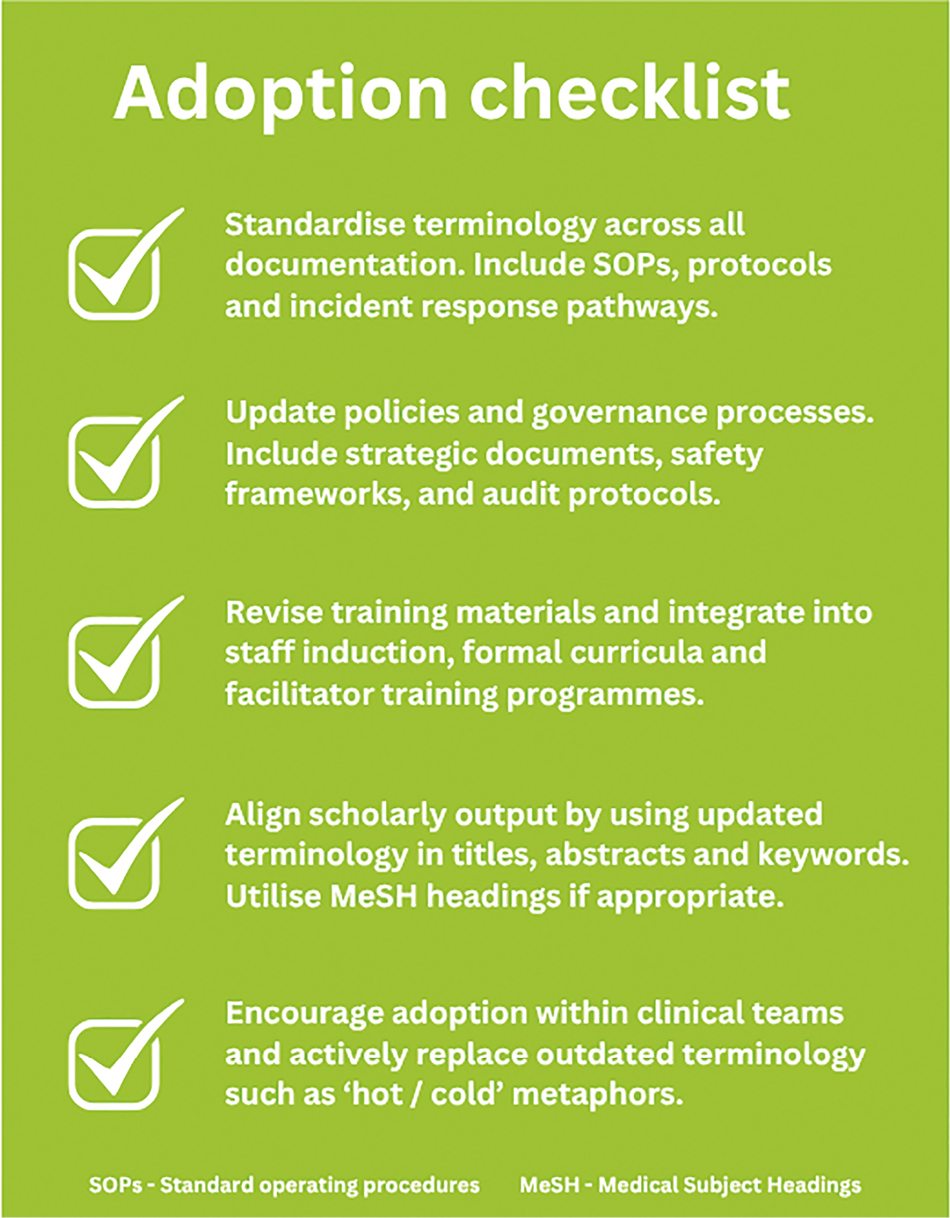
Suggested checklist for the adoption of ‘clinical debriefing’ terminology
Whilst the term ‘clinical debriefing’ encapsulates the broad and varied application of a structured group reflection and analysis in a healthcare setting, it remains essential for individual departments and institutions to be clear about the purpose of debriefing in their own context. We acknowledge that numerous barriers limit widespread implementation of clinical debriefing, such as a lack of time, unavailability of skilled facilitators and a workplace culture that does not support or prioritise the practice [13]. These undoubtedly must be addressed in their own right. Nonetheless, we strongly believe that unifying terminology is an important step forward and will promote its uptake.
We thank Paul Mullan and several colleagues for their thoughtful comments, which strengthened earlier versions of this manuscript.
Stephen Richard Waite: Conceptualisation, writing (original draft, review and editing).
Charlotte Jane Dewdney: Conceptualisation, writing (review and editing).
Emma Claire Phillips: Conceptualisation, writing (review and editing).
Victoria Ruth Tallentire: Conceptualisation, writing (review and editing), supervision.
None declared.
None declared.
None declared.
The authors declare that they have no known competing financial interests or personal relationships that could have appeared to influence the work reported in this paper.
1.
2.
3.
4.
5.
6.
7.
8.
9.
10.
11.
12.
13.
14.
15.
16.
17.
18.
19.
20.
21.
22.
23.
24.
25.
26.
27.
28.
29.
30.
31.
32.
33.
 Clinical debriefing: a call for clarity in terminology
 Facebook
 Twitter
 Linkedin
 Whatsapp

![Varied terminology in published work on debriefing in clinical environments [5,6,18–20]](/dataresources/articles/content-1781934605277-11fcc1f3-6406-4150-a5a9-49554c280faa/assets/mign3858_f0001.jpg)
![Subtypes of clinical debriefing [5,8]](/dataresources/articles/content-1781934605277-11fcc1f3-6406-4150-a5a9-49554c280faa/assets/mign3858_f0002.jpg)