


This article introduces the concept of ‘meta-simulation game world design’ for healthcare education. This innovative approach integrates multiple evidence-informed instructional strategies into a curated series of integrated and progressively complex simulation experiences (a meta-simulation) set within an immersive game world – a simulated, fictional universe governed by its own rules. Drawing on our experience designing The Carthage Codex, a meta-simulation game world for long-term care specialization, we outline our method and detail the 12 design steps, from initial planning to evaluation. Each step is illustrated with practical examples to guide and inspire readers in developing their own meta-simulation game worlds. Additionally, we emphasize the importance of ethical, cost-effective and reusable design practices to maximize educational impact and sustainability. This article aims to advance the integration of simulation, game-based learning and storytelling by presenting a flexible 12-step approach for designing immersive and impactful healthcare learning experiences.
Key messages:
Describes the first known use of a meta-simulation game world in healthcare education.
Advances the integration of simulation, game-based learning and storytelling in healthcare education.
Presents a flexible 12-step approach for designing immersive and impactful healthcare learning experiences.
Demonstrates how a meta-simulation game world can support the achievement of broad educational aims (e.g. related to clinical specialization, professional socialization, interprofessional care and readiness for values-based practice) using the example of long-term care specialization.
Illustrates the potential of using a meta-simulation game world to create an accessible and scalable learning solution to meet the challenges of standardized training of learners at a distance, in different locations and across programmes with varying schedules
Learning solutions are urgently needed for healthcare providers of older adults in Canadian long-term care (LTC) settings [1,2]. In Canada, LTC refers to residential settings for individuals who require around-the-clock health and social care. This critical situation has been caused by various factors. As with much of the world, Canada’s population is rapidly aging, and the demand for LTC is at an all-time high. At the same time, global demographic population changes are transforming healthcare labour forces, and many formal caregivers are retiring, causing shortages in staffing [3]. The coronavirus disease 2019 (COVID-19) pandemic further increased labour market competition and led to uncertain and declining opportunities for in-person student clinical placements and education [4,5].
As the education team at the Ontario Centres for Learning, Research and Innovation in Long-Term Care at the Baycrest Academy for Research and Education, we support the learning needs of current and future direct care practitioners across hundreds of geographically dispersed LTC homes and schools in Ontario. With extensive experience developing educational experiences and materials for this workforce, we sought to create an effective, accessible and scalable training solution. Our needs assessment – incorporating literature reviews, policy analysis and consultations with those who live, work, learn and teach in this sector – highlighted workforce shortages and training gaps exacerbated by the pandemic. As such, we prioritized education for new hires and student nurses, as well as unregulated care workers (referred to as Personal Support Workers or PSWs in our context), to strengthen workforce readiness.
Our educational aims were threefold: (1) to attract new learners to the field to meet the increased demand for direct care practitioners; (2) to create innovative and engaging modes of learning that can be delivered virtually and in a scalable manner; and (3) to equip current and future practitioners with the knowledge, interprofessional skills, values and behaviours to meet specialized care needs and to become professionally socialized to their speciality practice area and role. The overall goal was to create a learning experience that promoted a career in LTC as being rewarding, requiring a unique set of skills and involving positive relationships [6] that promote key elements of a framework for practice, such as security, belonging, purpose, continuity, achievement and significance for those who live and work in this practice setting [7]. First and foremost, we sought to embed the learning in a values-based practice that matched the context in which learning would be applied to their future career as direct care practitioners with older adults. Key values included curiosity, respect, dignity, autonomy and compassion in the care of older adults, allowing learners to become socialized to the setting, the team and their role while experiencing the successful application of care competencies.
These learners are largely immigrants [8] and are predominantly women (90%) who speak English as a second language (60%) [3,9]. Furthermore, PSWs have great variability in their training [10], and we have observed that although they tend to value intergenerational family relationships and informal care, some were less familiar with the purpose of a formal care setting (especially internationally educated workers). The needs assessment also indicated that we should continue to build on our existing knowledge and established approaches in healthcare training for this sector [6]. Our experience with these learners suggested that they embraced stories, simulations and serious educational games (games that apply game rules, referred to as game-based learning, to serious content for the purpose of achieving learning outcomes and performance behaviours) [11].
Serious educational games hold increasing promise as an instructional strategy in healthcare education [12–14]. As a form of simulation, game-based learning provides structured opportunities for learners to rehearse competencies and receive feedback [15]. Games can vary widely in design, ranging from the integration of gamification elements (e.g. points, badges, leaderboards) to deep game design features (e.g. in-game economies, open worlds). In gamification-based applications, learners are often engaged in discrete, narrowly focused tasks that are enhanced with basic game elements, such as earning points in a branching simulation or an escape room scenario. At the more immersive end of the design spectrum, deep games integrate interactive game mechanics that support learning efficacy and foster more complex clinical reasoning skills. Storytelling is often used to structure these experiences – engaging learners emotionally, guiding knowledge structuring, and fostering personal and professional growth through a meaningful, reflective learning journey [16].
Table 1 defines game terms and design elements used in this article.

| Game rule term/design element | Description |
|---|---|
| Activity feed | A design element that supports asynchronous engagement loops by listing completed player actions in real time. |
| Badges | Achievements that learners earn as a one-time recognition of effort and/or competency and enhance self-directed learning. |
| Engagement loops | Positive reinforcing cycles related to progression, achievement, social interaction, challenges and/or the storyline. |
| Game assets | Visual or audio content such as font, colours, imagery, video, audio or graphics. |
| Game currency | A form of a game resource that a player acquires by playing the game. |
| Gating | A design element that restricts the progression of game-play by requiring specific content to be achieved (e.g. solving tasks in one section before unlocking another, more complex section of content), allowing the learner to progress in the game. |
| Leaderboard | A design element that supports asynchronous engagement loops by highlighting the highest score achievements by players. |
| Levelling up | The action of a player moving from one level to the next level. |
| Levels | Refers to the movement of a player from one level to the next. |
| Newsfeed | A stream of posts, updates and content related to the game. |
| Progress bars | A design element that supports asynchronous engagement loops by visually displaying the completion status (e.g. percentage complete) of a given task, goal or process by the player. |
| Quest/s | A task, or set of tasks, to complete in order to earn game rewards (e.g. currency, token, badge). |
| XP points | XP or experience points are awarded when a player successfully completes a learning activity and are accumulated through playing the game. The player with the most XP points at the end wins. |
We built on academic research in the field and our expertise with these instructional strategies to create what we term a ‘meta-simulation game world’ (MSGW) called The Carthage Codex. We define meta-simulation as a curated series of integrated and progressively complex simulation-based experiences that support the delivery of a cohesive growth experience for the learner in a simulated practice setting and role. The meta-simulation is contained within a game world, a comprehensive simulated game environment located in a fictional universe with its own rule sets [17], enabling the learner to explore complex and interconnected knowledge, skills and attitudes.
The breadth and depth of a game world enable learners to make meaning of a learning experience through ‘worldness’ – the rich experience that arises from the interplay between game world design choices, aesthetics, rules and the player’s agency, interactions and experience within this fictional universe [17]. Our goal in creating an MSGW was to enable learners to connect with healthcare content in engaging ways that have been shown to activate centres in the brain associated with improved focus, decision-making, sense of reward and enjoyment [18–20]. An MSGW also promotes situational interest (i.e. an affective response in the learner that focuses their attention on the task), perceived control (e.g. through choice, autonomy) and positive appraised value of learning activities (i.e. positive emotions associated with achievement of tasks and mastery) in the game design to enhance intrinsically motivated learning [21]. Unlike the structured experience within a learning management system, an MSGW enables learners to self-direct their learning and pursue their interests (e.g. choice of topic, order, storyline action, special powers).
Although used in computer science and data modelling, the term ‘meta-simulation’ is defined and understood differently in these fields [22,23]. To the best of our knowledge, The Carthage Codex is the first naming and use of an MSGW in healthcare education. The focus of this article is to share some fundamental design concepts drawn from the field of serious educational games that were used in combination with standards of best practice for simulation design [24] and storytelling principles [16] to create The Carthage Codex.
A learner’s initial introduction to The Carthage Codex includes interacting with imagery, video, text and audio, as they are invited into the fictional universe (where, when) and propelled forward in the game by the circumstances of the story (what), their role and the roles of other characters (who), and their mission (why) (see Figure 1). Try a demo of The Carthage Codex here: https://baycrest.teachwithreach.com/#/auth/login/H8D7C2. To get started, select ‘Create an Account’. Then return to this page to log in. For assistance, please submit a support desk ticket at: https://microcredential.on.spiceworks.com/portal.

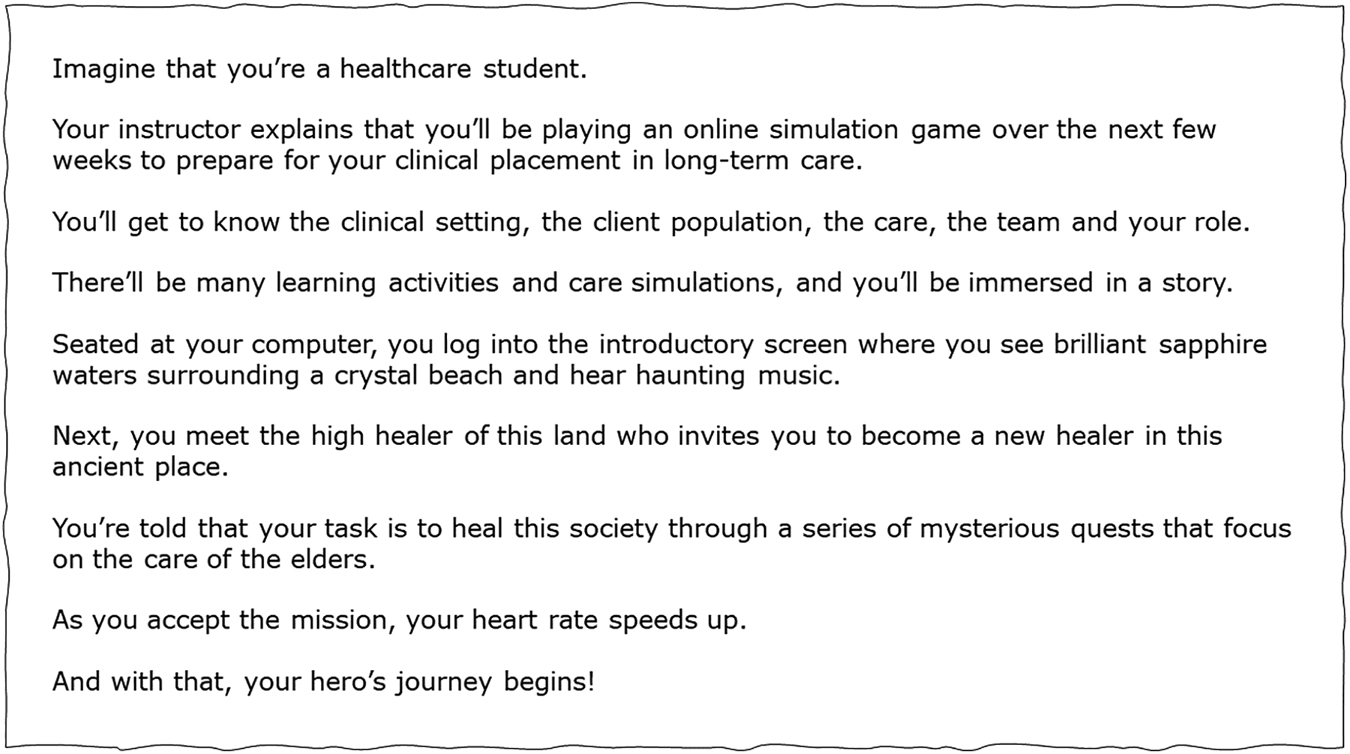
A learner’s introduction to The Carthage Codex.
The following 12 steps are presented as guidelines for the design of an MSGW, along with examples from The Carthage Codex (see Figure 2). Although outlined as a linear path, these steps are fluid and iterative and may be developed out of sequence or simultaneously (see Tables 2 and 3 for questions to consider for each step). Learner preparation for engagement and success is a key consideration in the design of an MSGW.
| Step | Questions to consider |
|---|---|
| Step 1: Select a platform | • What is the intended scale and delivery frequency of your MSGW? • What resources are available in terms of technology and human resources? |
| Step 2: Assemble the team | • What experience and competencies do team members have with the subject, simulation, game-based learning, game design and evaluation? • Given the platform selected, what additional technical expertise is needed? • Does the team have the necessary skills to titrate learning stress with regards to complexity, cognitive load, continuity, tempo and timing? |
| Step 3: Select educational framework | • Which educational philosophy is espoused by your team? • Which complementary educational framework will guide your design of the MSGW? |
| Step 4: Define instructional area | • What is the area of clinical specialization? • Are there pre-defined, measurable clinical competencies (e.g. knowledge, skills and values)? (Foundational Knowledge) • Are there professional or vocational standards with respect to roles, ethics, and setting? (Foundational Knowledge, Human Dimension) • What performance behaviours and values are expected or desired? • How will the experience help learners think holistically and make connections among differing perspectives, ideas, people, processes and events? (Integration) • What do you hope they will learn about themselves and their community? (Human Dimension) • What do you hope the learners will care about, become interested in and value? (Caring) • How do you hope your learners will grow as learners? (Learning how to learn) • What are the personal and professional life situations of learners? (Integration) • What prior knowledge, experience and initial feelings do they bring to this subject? (Foundational Knowledge, Integration, Caring) • What interests and strengths do they have? (Human Dimension) |
| Step 5: Choose a universe | • How will the game world setting enrich the learning experience and offer meaningful storyline potential? • Which aspects of the game world (e.g. culture, history, mythology, science and technology) will enable learners to achieve a better understanding of the area of specialization and the values you wish to impart? • Will the game world readily simulate the range of physical, psychological and technological experiences that characterize the clinical setting? • Will the game world support the performative range of the learning? (i.e. what learners are typically asked to do in the clinical setting) |
| Step 6: Craft the storyline | • Which type of story will engage learners and support their professional and personal growth? (Integration, Human Dimension) • How will the learner’s assigned role and the choices presented in the story foster learner agency? • How will the story connect content to emotion? (Caring) • Who will learners meet as mentors, allies and antagonists along the way? (Human Dimension) • How can specific values and behaviours be role modelled through characters or story scenes? (Caring) • How will the narrative reinforce professional standards and ethics? (Integration, Human Dimension) • How will the narrative generate a compelling desire to finish? |
| Step | Questions to consider |
|---|---|
| Step 7: Curate the style | • What style will suit the era, location and narrative, as well as appeal to learners? • How will the design target desired emotions in learners? • What senses will be (repeatedly) engaged? • Are the styles of assets readily available in the needed quantity? (e.g. cost and intellectual property considerations) |
| Step 8: Design the simulations | • What learning resources and simulations will you embed in the MSGW so that learners can achieve the desired competencies and performance behaviours? • How will learning resources and simulations be organized and gated to enhance learner agency and performance at increasingly higher levels of complexity? |
| Step 9: Create flow | • How will the learning experience be shaped to promote flow? • How will the unfolding of the game world and narrative align with and support successful mastery of increasingly complex learning? • Which game rules will be effective in achieving the desired learning objectives and performance outcomes? Consider knowledge, skills, application, behaviours and values. • How and when will game rules be introduced to renew learner engagement, while being mindful of cognitive load? • Which mechanics will foster motivation, self-directed learning, rewards and recognition? |
| Step 10: Foster psychological safety | • How will learners be introduced to and kept immersed in the game world? • How will learners be pre-briefed about the MSGW, the game world and its scope and their role? • What minimal instructions are necessary for learners to navigate the MSGW platform, including how to obtain help? • How will learners learn how to play and exit the game world? • Are feedback and encouragement provided using an appreciative tone, along with appropriate prompts and resources? |
| Step 11: Test and pilot | • Do discrete learning activities function as intended? Are they effective? • Do the game rules enable the learner to proceed effectively and smoothly through game-play? Can the game rules be subverted (i.e., can learners ‘break’ the game)? • Do learners navigate the game world as intended? Are choices and paths clear? • Does the learning feel cohesive and support growth as an integrated experience? • Are the components of the MSGW – goals, framework, competencies, universe, storyline progression, and simulation complexity—aligned and well-integrated? |
| Step 12: Evaluate effectiveness | • What frameworks will be used to evaluate the user experience, user interface and learning outcomes? • Will changes in knowledge, skills, and attitudes undergo summative evaluation? • How will meaningful change in learners (as defined in Step 6) be measured? • Are the evaluation activities embedded and rewarded in the game world? |
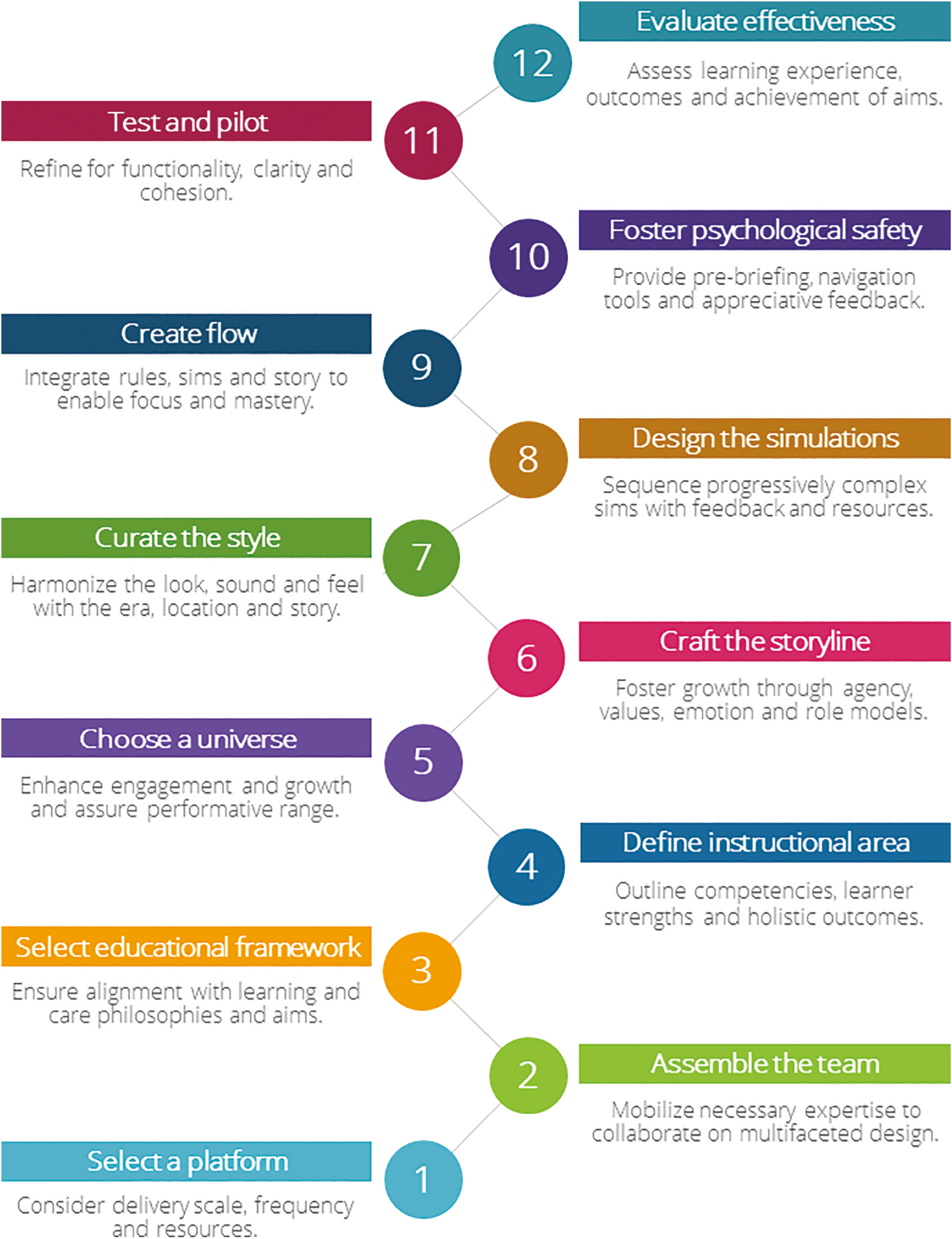
Twelve steps to design a meta-simulation game world for learning in health care.
MSGWs can be built by using a range of technologies, from basic (pen and paper) to sophisticated (software). Consider the planned reach, scale and availability of resources.
We needed to scale our educational solution to potentially hundreds of geographically dispersed organizations and thousands of learners, which required the use of advanced technologies to allow for automated, accessible and evaluable learning solutions. Importantly, the interface had to be simple for diverse educators to implement. We prototyped and co-developed, with game design experts and a vendor, software that served as a scalable, self-authoring and self-serve platform that could be accessed online through a personal computer and/or mobile device. These software capabilities enabled us to register learners and to create, manage, monitor and edit the learning experience autonomously and just-in-time.
Once the platform is selected, mobilize the team. Ideally, an MSGW is built by a collaborative team with diverse expertise and perspectives that draw on a range of fields of study.
We assembled a large interdisciplinary team that included simulationists, educators, instructional designers, researchers and clinical subject matter experts to support content development and evaluation. Developers, technologists and graphic designers addressed software design, security and maintenance, as well as the user interface and experience; game designers developed the game world.
An educational framework should guide the development of the MSGW’s content. Consistent with leading educational practices, the educational framework’s underpinning philosophy and its associated assumptions, beliefs and values should be logically and consistently applied throughout the MSGW to create a unified learning experience.
The alignment of content and this approach to learning was guided by Dr. L. Dee Fink’s (2013) constructivist Significant Learning Taxonomy [25]. Fink emphasizes the need for higher-level, learning-centred education to prepare learners for the real world. We integrated Fink’s six significant learning categories into the MSGW, including Foundational Knowledge, Application, Integration, the Human Dimension, Caring and Learning How to Learn (see Table 4 for a description of each learning category). Fink suggests these learning categories allow learners to carry meaningful, lasting change with them long after the learning experience has ended, which deeply resonates with our teaching and care philosophies and our aims for this project.
Specify the areas of instruction and the associated competencies that are required by the learners to perform their healthcare roles.
| Significant learning category | Description |
|---|---|
| Foundational knowledge | Encompasses key information, ideas and perspectives for learners to comprehend and remember in support of learners gaining a holistic, big picture understanding of the subject. |
| Application | Involves creating multiple ways for learners to use new knowledge, develop skills, problem solve creatively and think critically in support of making a difference in the world. |
| Integration | Ensures that learners can connect knowledge and ideas across bodies of knowledge and that interdisciplinary learning and communities of learning are supported. |
| Human dimension | Makes the subject relevant to learners and asks learners to better interact with oneself and others, thereby fostering pride and positivity and shaping learners’ self-image, self-ideal, humanness and interpersonal skills. |
| Caring | Cultivates new interests, feeling and values in learners, thereby deepening curiosity, generating joy in learning and creating the motivation to learn. |
| Learning how to learn | Enables learners to acquire competencies necessary for lifelong learning by generating capacity for and interest in continued learning. |
As the area of clinical specialization was LTC, we developed competencies for the following areas of instruction: gerontological and geriatric care, interprofessional care, relationship-centred care, and inclusive care planning and delivery. We created specific measurable objectives for each competency. For example, key competencies related to interprofessional care that we targeted included information sharing. A measurable objective associated with this competency was for the learner to demonstrate an appropriate method of communicating essential health information to others on the care team.
The fictional game world universe provides a setting to simulate the range of physical, psychological and technological experiences characterizing the clinical environment. It should also support the performative learning range that learners are expected to demonstrate [17]. Using a fictional universe, instead of a real-world setting, harnesses the power of drama, fantasy and symbolism to stimulate learners’ interest, emotions and recall, propelling them forward in the game world [26]. By providing context, novelty, suspense and emotion, the fictional universe activates the brain’s reward systems and enhances knowledge structuring.
Our fictional game world universe was loosely based on the civilization of Carthage in 800 BC. In keeping with historical legend, the founder was portrayed as a racialized and gendered subject: a young Phoenician woman, known as Queen Dido. We purposefully chose this setting because of its historical and cultural significance and rich mythology, and because it is popularly considered to have been shaped by strong female leadership. Thus, we hoped it would resonate with and inspire our largely female workforce. Even though ancient Carthage was a pre-industrial society, setting the game here suited the performative range of the learning because our LTC homes rely on critical human skills for care interventions. Learners have the opportunity to perform the full range of behaviours they would be expected to demonstrate in LTC practice (e.g. skilled dementia care, communication with family and team members).
The game world storyline should engage learners and support their professional and personal growth. Choose a storyline that resonates with the area of specialization and the learners (e.g. mystery, adventure). Organize the storyline into chapters as a way to progress the story in digestible, shorter chunks for the learner. In a game world, branching storylines enhance learner choice and agency. While all learners start and end at the same point in the story, they have the freedom to explore different paths along the way. Consider how the learner’s assigned role and choices presented in the story will foster their agency. Promote caring in learners by connecting content to emotions. Select the mentors, allies and antagonists that learners will meet, as well as specific values and behaviours that can be modelled through interactions with these characters. Generate a compelling desire in learners to finish.
We selected the classic ‘hero’s journey’ for the storyline. That is, learners were called to go on a heroic mission in an unknown world, in service of humanity. In this fictional world, each learner met allies, experienced challenges, overcame an ordeal, experienced a revelation and returned home transformed. Learners took on the role of Alyssa, an apprenticing/novice healer in a guild of healers, on a mission in service of the care of older adults. Through this journey, learners were immersed in residents’ lives to promote their understanding of, and reflection about, each resident’s psychosocial care needs (e.g. their personhood, familial relationships, customs, history, environment). The storyline consisted of a prologue, 18 chapters and an epilogue. Within the chapters, learners could choose to follow different branches of the story on their journey where they interacted with other characters (e.g. care team members, the High Healer, allies, villains and mystics). At times, these characters role modelled values or acted as mentors. Through this journey, we hoped to elicit emotions in learners such as anticipation, satisfaction, curiosity, engagement, empathy and compassion. As learning activities in the game became increasingly complex, events in the storyline became increasingly challenging. Thus, the storyline reinforced the notion that becoming a healer requires effort, tenacity and mentoring to overcome setbacks and develop expertise. We harnessed the storyline to support learners in taking pride in their ability to overcome challenges as they advanced through the MSGW, and so, to become a ‘hero’ meant successfully acquiring the competencies needed to provide evidence-informed care to residents.
Strive for internal consistency in the look and feel of the game through careful curation of the gaming assets, including fonts, colours, imagery, video, audio and graphics. Creating a unified, coherent game world experience can increase the potential for learner investment and engagement. The use of varied, meaningful stimuli at recurrent intervals taps into the brain’s affinity for novelty and is associated with better perception, action, motivation, exploratory behaviour and learning [27]. Choices can range from stylized (e.g. animé) to realistic (e.g. photographs) representations. Also consider how visual representations of information (e.g. shape, colour) can induce emotions, which, in turn, can impact learning comprehension and transfer [21]. To minimize cognitive load, balance including enough new relevant visuals that learners can be recurrently engaged and motivated, and yet not so many details that learners become overwhelmed or distracted [28].
For the gaming assets, we curated a consistent style of images and videos (both real and AI-generated) of people, avatars, places, nature and artefacts that were meaningfully tied to the game world storyline. We adapted an ‘ancient-themed’ game user interface and game assets (e.g. hand-drawn icons representing ancient scrolls, pre-industrial tools). We selected photographic images of older adults to represent the simulated residents. Our intention was to honour the age and lives of residents whose stories were part of the MSGW. Photographs of landscapes, nature and artefacts were chosen to simulate the reported beauty of the region and to honour its rich history. Where possible, we sought to frame the view of the photographs and videos from the direct perspective of the learner (i.e. in a first-person point of view, as though the learner was in the scene, interacting with the simulated resident or team members, or within the setting). For audio, we used string and percussion sounds that were suited to a world set in 800 BC.
In an MSGW, simulations are layered, integrated, repeatable and progressively complex to support cognitive and meta-cognitive processes associated with the development of expertise [29]. For example, clinical expertise requires pattern recognition of health conditions and mental models of clinical decision-making. To enable learner autonomy and self-directed learning, offer choice within groupings of similar simulations. In addition, learning resources (e.g. videos, quizzes, fact sheets, journal articles, media links) are needed to support just-in-time learning. These resources provide learners with immediate, relevant content to help them process their learning and move through the game in relation to the simulations.
As simulations and learning resources are designed, Step 8 also involves creating assessment procedures that replicate real-world care scenarios in a plausible fictional setting and that (1) are forward-looking (i.e. evaluate how well the learner can use knowledge of x, y and z do to a complex task); (2) are based on criteria and standards; (3) provide multiple opportunities for learner self-assessment and mastery (as described in Step 9) and (4) are accompanied by supportive feedback that discriminates between more and less effective approaches, and that is frequent, immediate and consistent with Step 10, empathetic [25].
With respect to progressively complex simulations, we designed two levels of simulation. In the first level, we presented learners with text-based mini-simulations involving interactions with various older adults living in an LTC home who were represented by photographs. These brief simulations enabled rapid skill building (drawn from an interprofessional clinical framework) [30], whereby learners assessed part of a clinical situation and applied one discrete skill. For each skill, the learner worked through 10–15 short scenarios and completed multiple-choice answers. Learning was further supported by just-in-time resources such as a one-page fact sheet related to the skill that could be bookmarked within the game, downloaded or printed.
Our first level also presented learners with fundamental quests (e.g. mini-simulations with short quizzes related to introducing and reinforcing basic knowledge about age-related changes). A quest is an in-game mission that is part of the Hero’s Journey and is designed to enrich performance in the simulations and support socialization to the role and setting (e.g. recognition of one’s responsibility as an advocate for residents). Learners were prompted to complete brief learning activities, supported by quizzes, in order to move forward in their Hero’s Journey.
In our second level of simulation, learners applied first-level simulation learning to engage with more complex case-based scenarios and more in-depth, specialty quests. These quests might include access to a journal article to deepen learners’ understanding of the resident’s health conditions, activities of daily living and advanced care needs. This second level involved text-based scenarios accompanied by photographs of the residents that involved the ongoing care of eight residents to illustrate the diversity that exists in an LTC resident population. Because care practitioners needed to understand the experiences of daily life in care, the simulations needed to highlight residents’ clinical needs, as well as the social experience of living in care. Our intention was to have players witness, engage with and be drawn into the lives of these residents who experience changes in health conditions and care needs over time. Each resident had three progressively complex sequential scenarios [31] that followed their life path in LTC.
To ensure a progressive, rewarding and coherent learning experience in an MSGW, integrate the meta-simulation, game world and the storyline. This integration helps learners experience flow which ‘… is what you feel when you’re doing things that are so enjoyable that you want to pursue them for their own sake’ ([32], p.132). In the educational realm, learning activities that flow align clear objectives with immediate feedback and increasingly complex challenges for which the learner has the pre-requisite skills and at which they can succeed, while enjoying the experience. This dynamic engagement supports learners to engage fully with the content, lose awareness of self and time, and readily block external stimuli, resulting in deep focus and enjoyment of what they are doing [32].
Game rules are an integral feature of game worlds that structure and guide what the player must do at the start, during and at the end of the game. In addition, game rules help to create self-organizing learning environments, which are designed flexibly to offer choice in support of learners’ curiosity (i.e. their need to know) and their interactions with others in a learning space like an MSGW [33]. Game rules can also promote learning efficacy and objectives by rewarding skill rehearsal and desired attitudes and behaviours.
An abundance of potential game rules can be used to create an MSGW [26]. We highlight some foundational rules to consider, along with some selected supporting design elements (see Table 1). Gating restricts the progression of game-play by requiring specific content to be achieved (e.g. solving tasks in one section before unlocking another, more complex section of content), allowing the learner to progress in the game. Levels allow the player to move from one level to the next, known as levelling up, through XP (experience points), which are awarded when the player successfully completes the learning activities. Design techniques that indicate levelling up have occurred include visual stimuli (e.g. pop-up windows) and sounds (e.g. a bell). The story chapters are spread out across levels, allowing players to progressively discover more about their hero’s journey and its relationship to the content. Engagement loops continually drive learners forward in the story and the learning experience, for example, in relation to frequency of levelling up, skill progression, task achievement, social interactions and challenges. It is important to balance engagement loops relative to the amount of content and time spent on the game in order to titrate the cognitive load, so that learners are challenged appropriately. Striking a balance between story content and frequency relative to learning aims is an art. Too much story can overwhelm players, while too little can lead to disengagement [34]. Design elements that support asynchronous engagement loops include progress bars (for individual performance), leaderboards (that highlight highest score achievements by players), activity feeds (that list completed actions by all players in real time) and badges (achievements that learners earn as a one-time recognition of effort and/or competency and enhance self-directed learning) [18]. Game resources (e.g. points, currencies, levels, tools) are part of the virtual game economy that is managed, produced and used by players. These resources foster motivation to continue in the game by promoting anticipation, competition, recognition and strategy [26]. The game economy should reward and reinforce targeted knowledge, skills, values and behaviours. The assignment of game resources to a learning activity cues the learner to its proportional complexity, value and required effort [33]. Practice or rehearsal of learning activities can be rewarded through mastery points.
To balance engagement loops and to manage cognitive load, we worked with game designers to titrate the content and the learning activities. This meant that The Carthage Codex was designed with 80 levels of game-play for an estimated 35 hours of content. This strategy aimed to ensure adequate frequency of levelling up (i.e. every 26 minutes). A new story chapter unlocked every fourth level. Within each gated section of the game, learners explored and made choices about how to move to the next level (e.g. choosing the order in which to assess residents in the mini-simulations, which then unlocked a challenge with the High Healer). Levelling up was celebrated in the form of a pop-up window with a scenic Mediterranean image and a harp sound. With respect to other engagement loops, learners could self-monitor progress bars for levels, library resources and badges. Because learners played solo and asynchronously in this version of the game, social interaction engagement loops consisted of an automated leaderboard (for experience and mastery points) and activity feed.
A digital badging system recognized and rewarded the achievement of key care competencies (e.g. advocacy, family engagement, assessment, acute deterioration, activities of daily living, falls prevention, palliative care), care of virtual simulated residents (i.e. tokens of appreciation at end of care scenarios), and mastery and game milestones (e.g. related to repetition of simulation activities and progression in the library and storyline).
The game economy consisted of a system of points and currencies that could be used to purchase items. For example, we called our system of points ‘experience points (XP)’, which were a cumulative resource earned upon successful completion of each learning activity. Upon successful completion of quest and simulation activities, gold was earned as a currency; in turn, gold could be spent to purchase special powers and guidance to advance through the game. For example, interprofessional team consultations could be purchased with gold to provide team perspectives, fostering collaboration for each simulated case scenario. We used game resources to weight learning activities to ensure that learners were drawn to and rewarded for higher-order learning (e.g. 50 XP earned for a library quiz vs 250 XP earned for a full resident simulation).
Psychological safety in a learning environment is defined as ‘… the degree to which people view the environment as conducive to interpersonally risky behaviors like speaking up or asking for help’ ([35], p.66) During in-person or synchronous simulations, facilitators work to foster psychological safety and are guided by standards of practice that include facilitation, prebriefing and debriefing [36–38]. However, if an MSGW is fully asynchronous, then there are no live facilitators to prebrief/debrief learners in real time. Prebriefing materials [39] for an asynchronous MSGW are essential to orient learners to the process of learning within the game world (scope, navigation), their role, the rules, the conditions for success and, if included, any pre- and post-assessment. Providing contact information for learners experiencing technical difficulties or with content questions is also part of fostering psychological safety. Similarly, strategies to replace a live facilitator and an in-person debriefing are important to include to provide appreciative feedback and to prompt reflection as a player progresses through the game.
We created a set of in-game prebriefing materials for learners, which included short exercises that oriented them to the game world universe, user interface and game rules. We also provided them with a game map to support their understanding of game flow, self-monitoring of progress, exploration and self-directed learning by topic, tracking of achievement, and navigation of their journey.
In response to early player feedback requesting further prebriefing and orientation, we created three short interactive quests related to the fictional game world environment, their role as a healer within this environment, and the rationale for having a pre- and post-assessment. Within this last quest, we made an explicit statement that we valued and appreciated their willingness to engage in the pre-assessment, while reassuring them that no preparation was necessary. We presented the pre-assessment as an opportunity for players to discover independently their areas of strength and their learning needs. We reassured learners that they would subsequently receive support and resources to succeed in the game. Finally, to foster enthusiasm for the game process, we stated our confidence in their ability to progress and succeed toward their goal of graduating as a full healer. We also provided contact information for them should they experience technological difficulties with the website (see Table 5).
In lieu of a facilitator and in-person debriefings, we used a variety of methods for learners to receive feedback and to self-assess their progress. Written with an appreciative tone, feedback for answers was provided through instant, automated tips and reflective prompts, which (1) reinforced best practice and/or rationale behind correct responses; (2) prompted reflection to improve application of learning within the simulations; (3) encouraged and rewarded the learner for meeting targeted outcomes; (4) redirected the learner to key resources or learnings to promote success after an incorrect response; and (5) acknowledged the complexity of clinical practice where many factors must be considered correctly for an optimal response.
Test individual learning simulations and resources and pilot the MSGW to establish coherence of the overall experience. Involve a variety of learners/players who represent the target audience as well as other relevant parties, such as designers and educators, to help identify and mitigate confusing, missing, or incorrect elements and functions. If possible, start by piloting the MSGW with a discrete group of learners prior to scaling. During this step, gather data from as many relevant sources as possible.
| Prebriefing material | Description |
|---|---|
| Game world introduction | Imagery, video, text and music immersed learners in the fictional universe (where, when), the circumstances of the story (what), the role of the characters (who) and their mission (why). |
| User interface orientation | An automated pop-up tour highlighted the interface functionality (e.g. currency and progress bars, badges, buttons, newsfeed). |
| Game-play orientation | A series of short videos, in the form of quests, provided guidance on how to navigate, play and complete game actions. |
| Game maps | Visual representations that supported (a) an understanding of game flow and gating; (b) self-monitoring of progress; (c) exploration and self-directed learning by topic; (d) tracking of achievements and (e) navigation of learning resources. |
| Orientation to your role in the game: Get Ready 1 – Game World | A quest that apprised the learner that they are situated in a virtual learning space that is a game-based simulation experience (i.e. the modality), that is set in a fictional world in which they will role-play (i.e. expectations). |
| Orientation to your role in the game: Get Ready 2 – Your Role | A quest that assured the learner that they belong in this learning community (i.e. a group of new healers in training) and have a clear identity (i.e. name, role) and purpose in this world (i.e. a mission to learn how to care). |
| Orientation to your role in the game: Get Ready 3 - Join the Guild! | A quest that prepared learners for pre-assessment by clarifying the steps (i.e. a survey and three training simulations) and purpose (i.e. to understand the new healers who are joining). Valued and appreciated learner willingness to engage in these activities while reassuring them that no preparation was necessary (i.e. this is an opportunity for them to discover their areas of strength and their learning needs on their own). Explained that learners will subsequently receive support and resources to succeed in the game. Also explained that learners will have the opportunity to complete post-assessments while specifying confidence in their ability to progress and grow (i.e. at which time they will graduate as full healers). |
We tested The Carthage Codex students, direct care providers, serious game experts, technologists, instructors and administrators. Testers provided feedback related to game design, usability, game flow, content and the storyline. Iterative revisions were then made to the MSGW to address confusing, missing or underdeveloped elements prior to implementation. We piloted the MSGW with two discrete groups of learners (students and LTC practitioners) and implemented their feedback before scaling.
In addition to evaluating learning and performance outcomes, it is also necessary to assess the content, learning experience, user interface and technological aspects of the game. During early implementation, user feedback helps to refine the MSGW. Be sure to evaluate the overall educational aims of the MSGW. Ongoing evaluation provides data on the learning experience and the continuing relevance of the MSGW.
We conducted a comprehensive process evaluation [40]. Although it is beyond the scope of this paper to report in detail on the evaluation process, data collection methods included implementation notes, app usage metrics, platform analytics, in-app and follow-up surveys, and interviews with end users.
Our goal in writing this article was to contribute to an emergent, innovative area of healthcare education and training for a sector that is under significant pressure to overcome workforce shortages and to meet the care needs of an ageing population. The 12 steps of MSGW design articulated here detail how existing evidence-informed practices in simulation, serious educational games and storytelling, as well as other standards and frameworks, guided the development of our MSGW.
MSGWs allow for the achievement of broad educational aims (e.g. related to clinical specialization, professional socialization, interprofessional care and readiness for values-based practice). Importantly, we grounded these aims in a humanistic educational approach, specifically Fink’s Taxonomy of Significant Learning [25]. Fink’s approach emphasizes educational practices that are imbued with an ethics of care, aligning with the values central to health care. Our goal was to model relational practices that learners could then apply in their care of LTC residents. We also sought to create a game world and storyline with higher meaning that would foster professional and personal growth, supporting learners in developing their identity as compassionate healthcare practitioners. To uphold these principles, we deliberately avoided clichéd or counterproductive game settings, such as those centred on violence or themes misaligned with the ethics of care, focusing instead on environments that reflect the complexity and humanity of healthcare practice.
Combining simulation, serious games and storytelling into an MSGW allows for the possibility of an experiential, exploratory experience that suits our goal of engaging learners by drawing on their existing knowledge, real-world experiences and personal reflections [25]. MSGWs do this by encouraging self-directed learning and cultivating the realization in learners that it is possible to enjoy learning what may be initially perceived as ‘unexciting’ content.
MSGWs can provide structured exposure to interprofessional care through thoughtfully designed team interactions, even in asynchronous, solo play formats. Although this format does not fully replicate the complexity of real-time, in-person interprofessional dynamics, it offers scalable opportunities to introduce learners to core competencies such as role clarity, perspective-taking and collaborative decision-making – areas often difficult to address in traditional education due to logistical and financial barriers [40].
In The Carthage Codex, a key game rule embedded virtual interprofessional team consultations within each care simulation. Non-player team members were deliberately designed by educators and subject matter experts from multiple disciplines to reflect diverse professional perspectives and expected actions. This approach aimed to foster role clarity, interprofessional communication, teamwork and ethical decision-making, reinforced through integrated opportunities for reflection. Asynchronous virtual learning can be particularly effective for introducing students to foundational interprofessional competencies – such as role clarification and conflict resolution – and for preparing them for future collaborative experiences [41].
MSGWs can also integrate additional interprofessional learning strategies, including structured reflection prompts, artificially intelligent-driven team member bots and peer- or instructor-mediated exchanges. More advanced interprofessional dynamics – such as team functioning and collaborative leadership – typically require synchronous or real-time interaction [41]. Many variations are possible. For example, although this article focuses primarily on solo asynchronous play, we have also configured our MSGW to support asynchronous team-based challenges in which learners collaborate online to solve shared patient care goals. Although initially a resource-intensive endeavour, creating new MSGWs became very cost effective, once the initial software platform, as described in this article, was developed. Since the creation of The Carthage Codex for LTC education and training, we have leveraged the software platform and repurposed this particular game world to develop diverse meta-simulations tailored to varying degrees of difficulty, duration and healthcare roles. Organizations report using these varied learning packages for The Carthage Codex in many ways, including as a pre-placement activity; to augment, supplement or remediate clinical placements; and, for interprofessional learning, new hire onboarding, staff refreshers and acculturation of international healthcare providers. MSGWs can be designed in support of any clinical specialty.
At the time of writing, The Carthage Codex has been played by over 7,000 learners across Ontario, Canada and beyond. The scalability of an online MSGW across a large jurisdiction demonstrates the value and potential of this kind of educational solution. Evaluation will be reported on in subsequent papers. We are fully engaged in this exciting field of healthcare education innovation, and we hope to inspire readers to build on our experience to create their own MSGW.
We acknowledge George Brown College, Toronto Metropolitan University, and Launch57 for collaborating on an early software prototype through an eCampusOntario grant. We also extend our gratitude to the participating schools, LTC homes and system partners for their invaluable input and feedback. Special thanks to our collaborative partners – Launch57, the Kunen-Luninfeld Centre for Applied Research and Evaluation, and the Centre for Aging + Brain Health Innovation – for their ongoing support. We recognize the Bruyère Health Research Institute and the Research Institute for Aging for providing additional specialized content. We appreciate the clinical and educational contributions of educators Carey Burleigh, Shaina Davis, Rikki Karon, Emi Giddens, Daniel Galessiere, Dr. Birgit Pianosi, Kiira Poerschke, Laurie Bernick, Beverley Kramer and Jennifer Reguindin. Finally, we are grateful for the project implementation support provided by Rachel Walker, Natalie Leventhal, Matthew Goulbourne, Dr. Paula Mastrilli, Melissa Fernando, Corey Mroczkowski and Shahd Goneid, as well as to Dr. Meaghan Adams and Lisa Guttman-Sokoloff for their thoughtful manuscript review and valuable feedback.
Authors 1, 2 and 3 were involved in the study’s conception. All authors were involved in the design. The corresponding author took the lead in drafting the manuscript. All authors reviewed the content critically and approved the final version.
This work was funded in part by the Government of Ontario through the Ontario Centres for Learning, Research and Innovation in Long-Term Care at the Baycrest Academy for Research and Education. The views expressed in this article are those of the authors and do not necessarily reflect those of the funding agencies.
None declared.
None declared.
We have no conflicts of interest to disclose.
1.
2.
3.
4.
5.
6.
7.
8.
9.
10.
11.
12.
13.
14.
15.
16.
17.
18.
19.
20.
21.
22.
23.
24.
25.
26.
27.
28.
29.
30.
31.
32.
33.
34.
35.
36.
37.
38.
39.
40.
41.
 Twelve steps to design meta-simulation game worlds to foster the next generation of healthcare practitioners: the example of ‘The Carthage Codex’
 Facebook
 Twitter
 Linkedin
 Whatsapp
