


Over the past two to three decades, healthcare simulation evolved from a practice focused on replicating clinical procedures to approaches that supported collective inquiry, system redesign and cultural change in complex healthcare systems. While this shift had been widely acknowledged, less attention had been given to the design experiments through which simulation’s purposes and epistemology were reconfigured. Drawing on 25 years of collaborative work, this conceptual essay synthesised developments in hybrid, distributed and sequential simulation, alongside the concept of circles of focus, to examine how simulation moved beyond fidelity-driven replication towards intentional representation, emergence and reciprocal illumination. Relaxation of realism, productive use of imperfection and deliberate movement between task, interaction and cultural and systems-level concerns enabled insights and shared understanding that were inaccessible to conventional educational or evaluative methods. These insights informed the subsequent formalisation of Transformative Simulation, distinguishing simulation designed to educate from simulation designed to support practice and cultural and systems-level change through collective sensemaking.
What this essay adds
•Simulation can support collective inquiry, not only education, training or improvement.
•Imperfect simulation reveals work-as-done rather than idealised practice.
•Patient journeys can reveal forms of system fragmentation that may not be captured by standard metrics.
•Shared representations can support reciprocal illumination across professional roles.
•Transformative Simulation distinguishes education from cultural and systems-level change.
Healthcare simulation has traditionally been associated with the replication of clinical procedures, environments and technologies. Early developments prioritised realism and fidelity as markers of quality, aligning simulation closely with skill acquisition, technical rehearsal and performance [1,2]. As simulation matured, practitioners increasingly questioned whether replication alone could address the complex, relational and cultural and systems-level challenges facing modern healthcare.
This conceptual and reflective essay draws on more than 25 years of the authors’ simulation design experiences, alongside parallel developments across the wider simulation field, to examine the empirical and conceptual evolution that ultimately informed the development of the Transformative Simulation framework. Rather than presenting a formal historical review or methodological analysis, the essay offers a reflective synthesis of the design questions, practical experiences and conceptual developments that shaped this body of work. By integrating hybrid, distributed and sequential simulation with the concepts of circles of focus and reciprocal illumination, we trace how shifts in design practice reshaped what simulation could reveal, how it generated insight and why it has become a powerful method for collective inquiry and change. The framework of Transformative Simulation was developed after much of the work described in this essay had already taken place [3]. This essay therefore reflects retrospectively on the design experiments that ultimately informed its development and formalisation.
Simulation-Based Education (SBE) and Transformative Simulation represent complementary but distinct theoretical orientations to simulation. SBE organises simulation around pedagogical theories to support the development of knowledge, skills, behaviours and professional judgement, whereas Transformative Simulation organises simulation around Simulation-Based Intentions (SBIs) and theories of systems, organisational and social change to generate collective insight, understanding and action across existing systems of care [3,4]. Although the same simulation methods may be employed, the underlying design logic, facilitation, data collection and evaluation differ according to the organising principles. Rather than replacing SBE, Transformative Simulation offers an alternative lens through which simulation can be purposefully designed to address challenges that extend beyond educational goals alone. The conceptual relationship between SBE and Transformative Simulation has been explored in greater depth elsewhere [5] and provides useful context for understanding the historical evolution described in this essay.
Rather than providing a comprehensive chronology of every simulation undertaken, this essay intentionally focuses on a series of design moments that proved conceptually significant in the development of Transformative Simulation. These moments were selected because they marked shifts in how simulation was understood and designed, ultimately contributing to the articulation of the Transformative Simulation framework described in later publications [3,5].
For much of its early history, healthcare simulation was dominated by concepts of fidelity, realism and suspension of disbelief. These constructs were instrumental in legitimising simulation as an educational tool, particularly for procedural training [2,6–8]. However, they also reinforced the assumption that simulation’s primary purpose was to reproduce clinical reality as closely as possible – often without sufficient interrogation of whose reality was being replicated, which aspects of practice were prioritised, and why.
Simulation can never be a full replication of reality. By necessity, it involves selection: decisions about which elements of practice are represented, and which are omitted. These decisions shape attention, interpretation and action. Recognising simulation as a selective representation rather than a mirror of reality reframes perceived limitations as opportunities for intentional design. Kneebone has described this process as one of selecting, abstracting and re-presenting reality (Kneebone’s triad), emphasising that meaning is created not through completeness but through focus [9].
This shift mirrors developments in film-making. Early filmmakers attempted to capture entire scenes in continuous detail, believing that completeness would enhance realism. Over time, it became clear that such approaches overwhelmed viewers and diluted meaning. Cinematic practice evolved towards intentional framing – using cuts, close-ups, wide shots and sequencing to direct the viewer’s attention towards what was narratively and emotionally salient [10]. Crucially, realism was not lost; it was sharpened through focus.
This cinematic analogy is intended to illustrate the designer’s act of framing rather than to suggest that simulation itself is passive. Unlike film, simulation is inherently interactive, with participants actively shaping the unfolding experience within the frame that has been intentionally designed.
A similar principle operates in comic books and graphic narratives. Comic artists do not attempt to depict every moment of a story. Instead, they select key scenes – moments of action, interaction or tension – and place them into discrete panels [11]. Meaning is generated not only within individual frames but also through implied action in the ‘gutters’ between them. A close-up panel may draw attention to a facial expression or emotional state, while a subsequent wide shot situates that moment within a broader social or environmental context. What is left out is as important as what is shown.
Simulation design operates in much the same way. Designers must decide when to zoom in – for example, on a specific clinical process, behavioural exchange or moment of decision-making – and when to zoom out to reveal patterns across teams, pathways, cultures or systems. Fidelity, in this sense, is not about reproducing every detail of clinical reality, but about selecting and sequencing moments that illuminate what matters most for the purpose at hand. Simulation need not show everything; it must show what matters, and allow participants to move deliberately between levels of focus – process, behaviour, experience and system – through intentional framing.
An important conceptual development that helped articulate these design choices was the notion of circles of focus. This concept highlights how simulation can deliberately shift attention between different layers of practice – ranging from technical task execution to team interaction, to organisational and system-level considerations [12,13]. Rather than treating these layers as separate or hierarchical, circles of focus emphasise their interdependence and the ways in which attention is dynamically allocated during practice. Unlike theories that describe how cognition or participation occurs, Circles of Focus is a practical design heuristic that helps determine what elements of a system should be brought into focus to align the simulation with its intended purpose.
The concept emerged from early experimental work exploring what clinicians attend to during simulated activity. In one study, a group of surgeons were invited to perform a surgical task using a highly realistic abdominal model. The technical focus of the task was supported by anatomically accurate tissue and instruments; however, the surrounding environment was intentionally low-fidelity (Figure 1). Instead of a fully replicated operating theatre, the wider context was suggested through lightweight, symbolic cues: pop-up theatre structures, banners with images of anaesthetic machines and trolleys, and ambient sound effects such as monitor beeps [14].

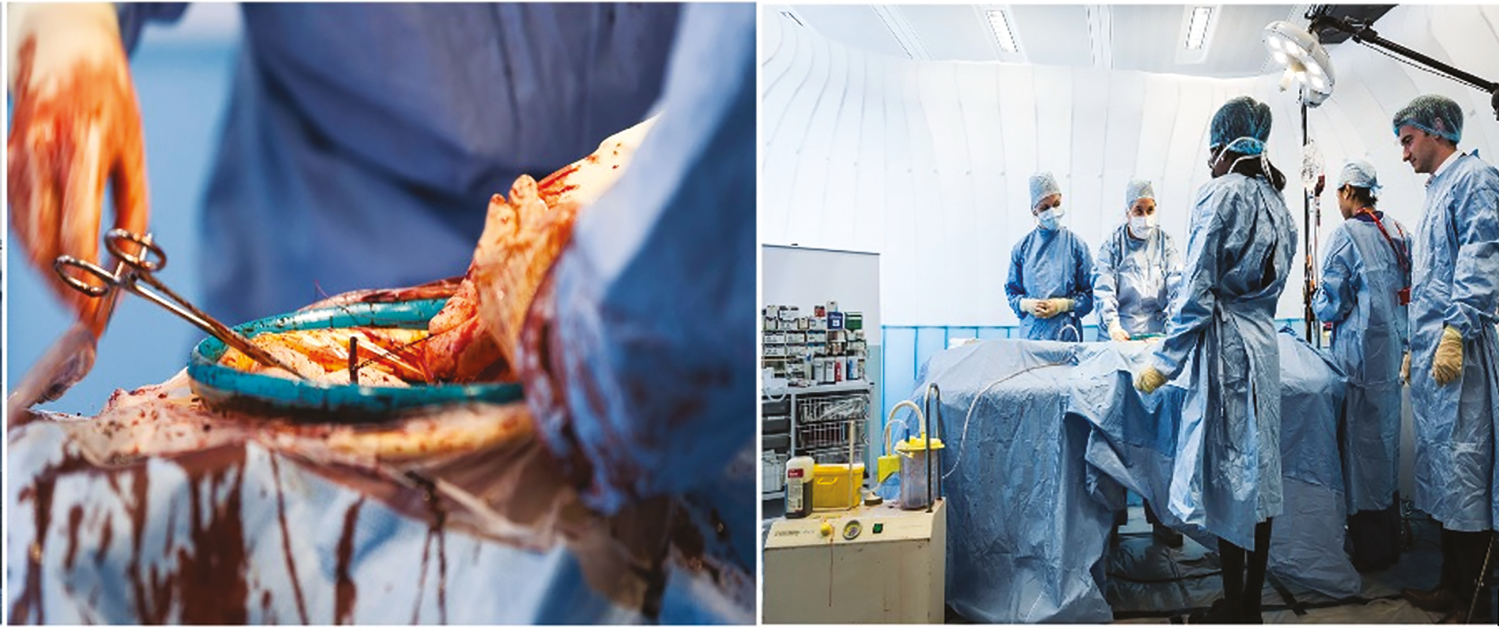
Illustration of the Circles of Focus concept. Left: a highly realistic abdominal task trainer with simulated blood, demonstrating a narrow focus on the procedural field. Right: a low-cost distributed simulation environment, illustrating a broader focus that incorporates the surrounding clinical team, environment and context
Following the exercise, the surgeons were asked how realistic the simulation had felt. Participants consistently described that it had felt ‘very real’. When subsequently shown images of the broader environment – including the banners and symbolic representations that had been present in their peripheral vision – they expressed surprise, often reporting that they had not consciously registered these elements during the task or recognised that they were not ‘real’ clinical equipment. Yet those same contextual cues, combined with sound and spatial arrangement, had clearly been sufficient to sustain immersion and orientation [13].
This observation was critical. It demonstrated that realism in simulation does not require uniform fidelity across all elements of the environment. Instead, participants naturally allocate attention according to task demands, focusing intensely on what is salient while relying on contextual cues in the periphery to maintain situational coherence. The simulation was experienced as real not because everything was replicated, but because the right things were in focus at the right time. This aligns with previous work by Dieckmann, Gaba and Rall work suggesting that perceived realism is shaped by participants’ engagement and interpretation rather than by physical replication alone [14].
Circles of focus provided a way of naming and designing for this phenomenon. Design decisions determine which circle is foregrounded – such as technical performance – while allowing other elements, including team dynamics, environment and organisational context, to remain perceptible in the background. Crucially, these background elements are not irrelevant; they shape behaviour, meaning and experience even when they are not the primary focus of attention.
This capacity to deliberately zoom in and out aligns with the understanding of simulation as intentional representation, where focus is actively shaped rather than passively inherited. Circles of focus thus offered a conceptual bridge between early hybrid simulation – where attention moved between task and interaction – and later system-oriented applications, where outer circles such as organisational culture, policy and patient experience became central objects of inquiry [3].
Hybrid simulation – combining physical task trainers with simulated patients and narrative context – marked a pivotal step in expanding simulation’s focus beyond isolated technical performance (Figure 2). Rather than treating procedures as decontextualised motor tasks, hybrid approaches foregrounded the inseparability of technical action from communication, identity and relational work [15]. This shift challenged the common educational assumption that complexity should be stripped away to facilitate learning, instead demonstrating that authentic clinical meaning could be preserved while still supporting skill acquisition [16,17].
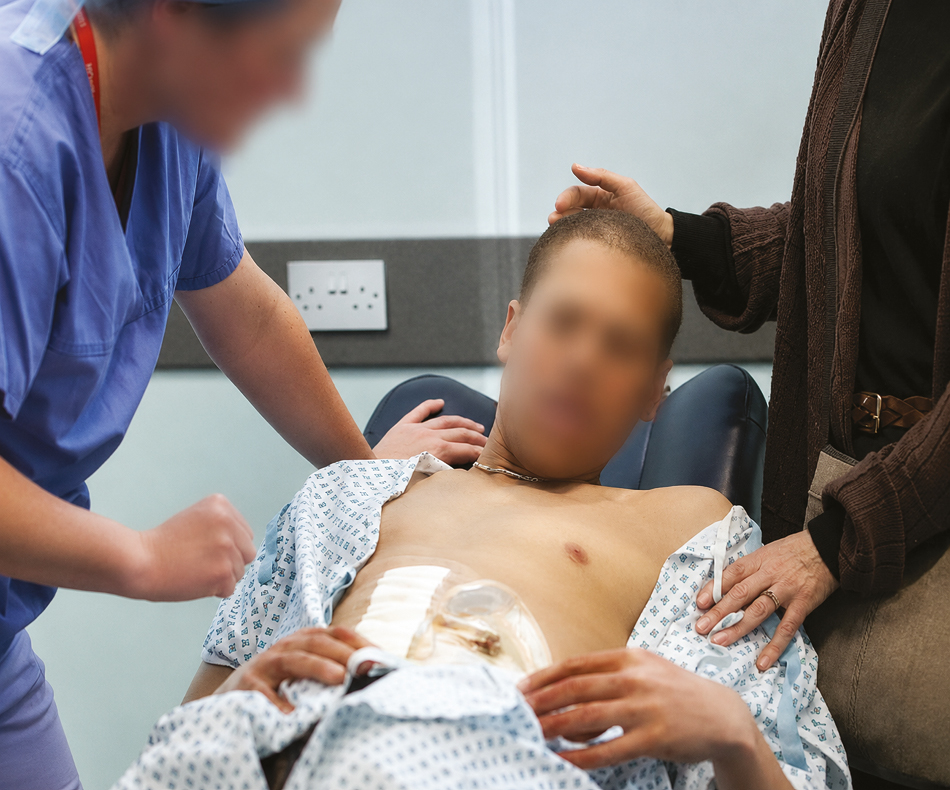
Illustration of hybrid simulation, in which a simulated patient is combined with a realistic stoma. This approach demonstrates the integration of procedural tasks, patient interaction and clinical meaning that characterised the evolution of hybrid simulation
This challenge aligns closely with Bereiter and Scardamalia’s distinction between experienced non-experts – those skilled at dealing with predictable, recurring patterns – and adaptive experts, who are capable of engaging productively with the unfamiliar. Adaptive experts deliberately seek out challenge, reinvesting their attentional resources in progressive problem solving rather than routine execution. Hybrid simulation created conditions in which such challenge could emerge, by reintroducing uncertainty, human unpredictability and relational complexity into procedural learning contexts [18,19].
Viewed through the lens of circles of focus, hybrid simulation enabled deliberate movement between inner circles of technical execution and adjacent circles of interaction and meaning. For example, in obstetric emergency training, physical models supported procedural rehearsal, while simulated patients foregrounded communication, stress, hierarchy and emotional response. Learners were required not only to do the procedure but also to negotiate its performance within a dynamic social and ethical landscape. Technical decisions were revealed to be inseparable from relational dynamics, foreshadowing later system-level applications [20].
This reframing resonates strongly with Meyer and Land’s work on threshold concepts, which they describe as portals to new, previously inaccessible ways of thinking – representing a transformed way of understanding that is often accompanied by discomfort, uncertainty and disorientation. Such transformation is irreversible: once crossed, the learner cannot return to their prior conceptual frame. Hybrid simulation functioned as a space in which these thresholds could be encountered safely, allowing learners to grapple with troublesome knowledge that challenged their existing assumptions about practice [19,21].
Transformation, in this sense, is an unsettling process. It involves confronting the gap between simplified representations of practice and the messy realities of clinical work. Rather than offering a sanitised simulacrum [22], hybrid simulation, used creatively, exposed this messiness and made it available for reflection. By doing so, it supported clinicians in crossing boundaries, developing shared mental models and beginning to ‘see the other side of the ha-ha’: recognising how perspectives differ across roles, levels of experience and positions within the system [19].
In retrospect, hybrid simulation can be understood as an early enactment of simulation’s transformational potential. It demonstrated that learning is not only about acquiring competence but also about undergoing conceptual change – about learning to tolerate uncertainty, integrate multiple perspectives and engage meaningfully with complexity. These insights would later be amplified through distributed and sequential simulation, and ultimately formalised within Transformative Simulation [3,23–36].
The development of distributed simulation marked a decisive turning point in the evolution of simulation practice. By freeing simulation from the physical, technological and organisational constraints of dedicated simulation centres, distributed approaches disrupted the assumption that simulation needed to be anchored in a single, static clinical room [23–25]. Portable, low-cost configurations made it possible to stage simulation in community settings, public venues and everyday work environments, widening participation and opening what had previously been described as the clinical insider frame (Figure 3) [9,26–34].
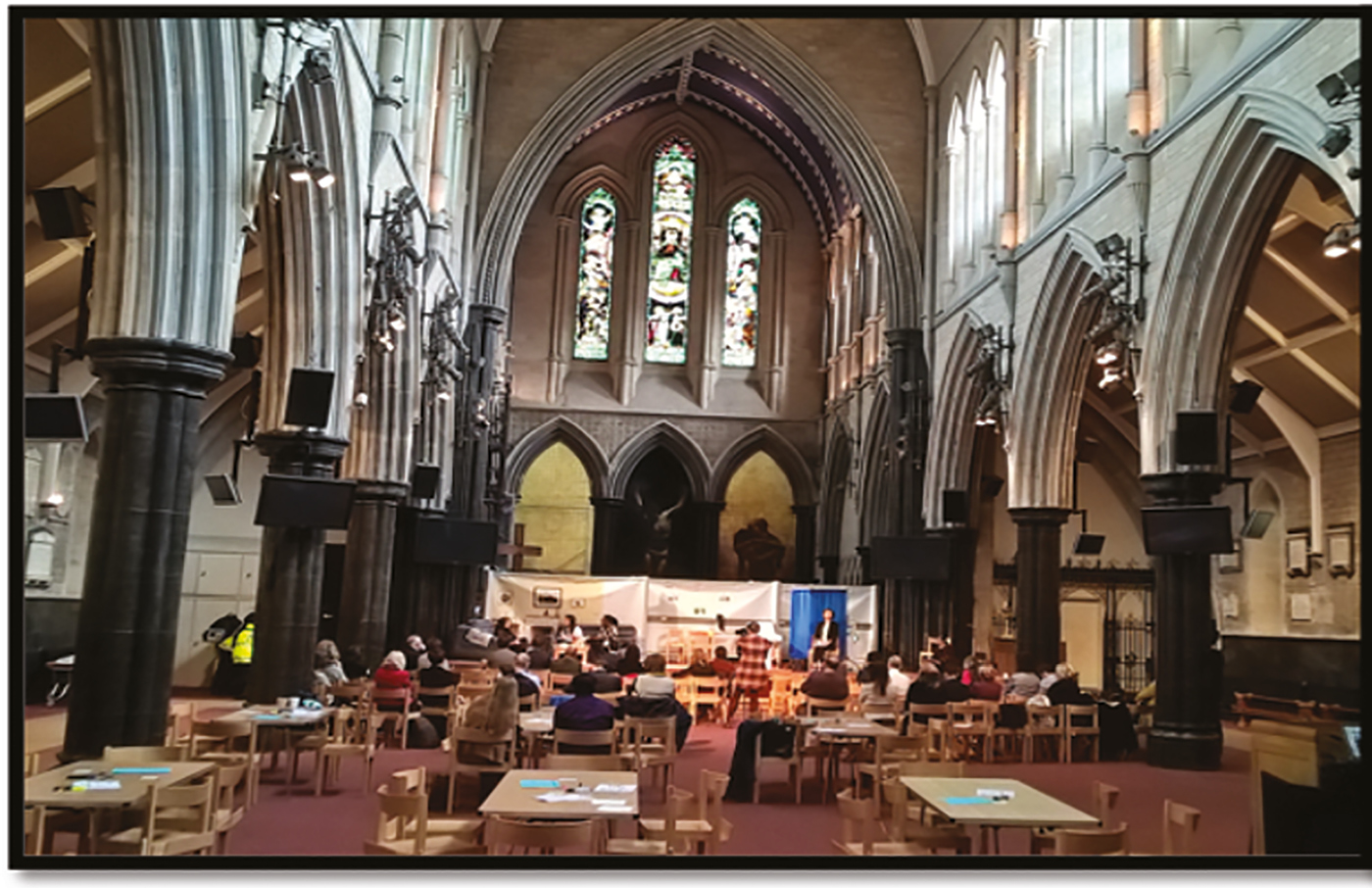
Illustration of distributed and sequential simulation. A patient care pathway is recreated within a community church, demonstrating how simulation became liberated from traditional simulation centres, enabling care journeys to be explored across multiple settings, stakeholders and stages of care. This scene depicts community, primary and secondary care
Distributed simulation therefore provided opportunities for public involvement. Throughout this essay, public involvement refers to the meaningful involvement of patients, people with lived experience and members of the public in simulation activities. The nature of that involvement varied depending on the purpose of the simulation, ranging from contributing lived experience and participating in simulation activities to informing design and collective inquiry.
This shift had profound implications for what simulation could represent. Once simulation was no longer tethered to a single room or a single clinical episode, it became possible to explore care as it is actually lived and experienced – across time, settings and professional boundaries. Distributed simulation enabled simulation designers to move beyond clinician-centred snapshots of practice and to begin asking different questions: not ‘How does this procedure unfold in a space?’, but ‘How does care unfold for this patient over time?’
Sequential simulation built directly on this liberation. By modelling trajectories of care rather than isolated events, sequential simulation made visible the longitudinal nature of healthcare delivery [28–34]. Attention shifted outwards, towards transitions, handovers, waiting, repetition and delay – features of care that are central to patient experience but often marginal to clinician-facing representations of practice. In doing so, simulation moved decisively from an episode-based logic to a pathway-based, and ultimately person-centred, logic [27].
Viewed through the lens of circles of focus, distributed and sequential simulation enabled deliberate movement towards the outer circles of practice. Rather than foregrounding a single task or interaction, these approaches allowed participants to see how local actions accumulated over time, how assumptions made in one setting shaped consequences in another and how system interfaces introduced friction, duplication or vulnerability. Participants could observe where understandings diverged between professional groups, where responsibility became blurred and where the patient’s experience of continuity or fragmentation emerged [35].
Illustrative applications included the collaborative remodelling of integrated care pathways [33], the mapping of maternity services across regional systems [36] and the engagement of publics in the design and implementation of point-of-care diagnostic technologies [32]. In each case, simulation functioned not as a rehearsal of clinical performance, but as a shared space for making sense of care trajectories. These simulations surfaced the informal negotiations, workarounds and adaptive practices that sustained care across time but remained largely invisible within formal pathways, metrics and organisational charts.
Crucially, this reframing repositioned the patient journey, not the clinical task, as the organising principle for simulation design. By allowing participants to experience care from the perspective of movement through the system, distributed and sequential simulation created conditions for collective inquiry into continuity, responsibility and experience. This patient-centred, longitudinal orientation laid essential groundwork for later system-level applications and for the development of Transformative Simulation as a framework explicitly concerned with intention, emergence and cultural and systems-level change [3].
Across hybrid, distributed and sequential simulation, a recurring insight was the productive role of imperfection. Highly realistic simulations often encouraged participants to perform idealised versions of practice, shaped by normative expectations of how care should unfold. In contrast, deliberately approximate simulations reshaped performativity and invited participants to respond as they would in everyday work, engaging with uncertainty, disruption and constraint.
A critical aspect of this shift was the removal of the expectation that participants should suspend disbelief. Traditional simulation practice often instructs participants to treat incomplete or non-functioning elements – such as a telephone that does not work – as if they were real. Paradoxically, this requirement can distance simulation from lived reality. In real clinical environments, equipment does fail, information is delayed and systems do not behave as intended. A non-working telephone is not implausible; it is a familiar feature of work-as-done.
By allowing such imperfections to stand, and by asking participants simply to do what they would do in practice, simulation created space for authentic responses. Rather than pretending, participants adapted. They sought alternatives, negotiated responsibilities, reprioritised tasks or articulated frustration. These responses closely mirrored how clinicians manage the messy realities of everyday practice, revealing the gap between formal processes and the adaptive strategies that sustain care.
Moments when the simulation did not align neatly with expectations proved particularly informative. They prompted participants to articulate tacit knowledge, surface local workarounds and expose system tensions that are often invisible in polished representations of care. In this way, imperfection functioned not as a deficit to be corrected, but as a methodological strength. It enabled simulation to illuminate work-as-done rather than work-as-imagined [37], generating insight into how healthcare systems actually function under conditions of uncertainty and constraint.
As simulation of this sort increasingly brought together clinicians, staff, managers, patients and publics, a distinctive process of reciprocal illumination emerged [38]. In complex healthcare systems, no single individual – whether clinician, manager or policymaker – has access to the full picture. Each occupies a partial vantage point shaped by role, responsibility and location within the system. Simulation created a shared representation through which these partial perspectives could be surfaced, juxtaposed and collectively examined [33].
Engagement with the simulation enabled participants not only to see the system differently but also to see each other differently. Clinicians became aware of organisational constraints beyond their immediate sphere; managers gained insight into the lived consequences of policy decisions; and professional silos softened as assumptions were challenged in real time. Meaning was generated not through consensus, but through the careful holding of difference – allowing multiple truths about the system to coexist and inform one another.
Within this process, the patient story proved central. Unlike professionals whose involvement is typically bounded by a particular setting or episode of care, patients experience the healthcare system longitudinally. Building on the train analogy described previously by Kneebone [9], the patient’s journey can be understood as akin to a train passing through multiple stations: primary care, emergency departments, diagnostic services, inpatient wards, interventional procedures and community follow-up. Each professional group encounters the patient at a single stop along the route; the patient alone experiences the journey in its entirety.
By situating clinical tasks within this lived trajectory, simulation foregrounded the patient’s perspective as a unifying thread across fragmented system encounters. This reframing elicited moral emotions such as empathy, responsibility and concern for continuity, motivating participants to engage in collective problem solving rather than isolated critique. It also revealed how well-intentioned local practices could accumulate into disjointed or burdensome experiences over time [33].
As participants engaged with the shared representation of the patient journey, shared mental models began to form in real time. These models were not imposed through top-down instruction, but emerged through dialogue, recognition and mutual sensemaking. Change, therefore, was not something done to participants, but something of which they became co-authors of – rooted in a deeper, collectively held understanding of how the system was experienced and where it might be reimagined.
A defining feature of simulation as collective inquiry was its capacity to generate emergent insight rather than predefined outputs. Unlike conventional evaluation approaches, which begin with assumptions about what should be measured and why, these simulations were deliberately designed to suspend such assumptions. Instead of asking participants to perform against predetermined metrics, simulation created a space in which unanticipated truths could become visible.
This distinction is critical. In complex healthcare systems, the most consequential dynamics are often those that are least amenable to advance specification. Emotional labour, moral injury, boundary tensions, informal negotiations and adaptive workarounds exert profound influence on system performance, yet they remain largely invisible within audits, dashboards and performance indicators. Their absence from formal measurement systems does not reflect a lack of importance, but a mismatch between what is measured and what actually matters.
By prioritising experience over abstraction, simulation enabled these elements to be encountered rather than merely reported. Participants did not simply describe emotional strain or moral tension; they felt it, recognised it in others and observed how it shaped decision-making and behaviour over time. This experiential quality was crucial. It transformed diffuse or tacit concerns into shared reference points that could be discussed without defensiveness or reductionism.
Importantly, emergence was not treated as noise to be controlled, but as data in its own right. Moments of discomfort, disagreement, hesitation or surprise signalled points where assumptions about the system no longer held. These moments invited inquiry rather than correction, allowing participants to question established narratives about roles, responsibilities and performance. In doing so, simulation revealed not only what was happening in the system but also why it was happening and how people were adapting in order to make care work.
This approach shifted the function of simulation from verification to discovery. Rather than confirming whether a process functioned as intended, simulation illuminated how care was actually accomplished under conditions of uncertainty, constraint and competing demands. The resulting insights supported more grounded conversations about leadership, culture and system improvement – conversations rooted not in abstract ideals or retrospective data, but in a collectively experienced understanding of the system as lived.
The work described throughout this essay was not originally conceived as Transformative Simulation. Rather, it represents 25 years of design experimentation across educational, public engagement, quality improvement and organisational contexts. As these different forms of simulation accumulated, it became increasingly apparent that they were being designed according to different underlying purposes and intentions and therefore required different approaches to design, facilitation, data collection and debriefing. At the same time, the simulation literature was beginning to use common language to describe practices that were pursuing markedly different aims. Transformative Simulation emerged retrospectively as a conceptual framework to explain these accumulated observations and to distinguish simulation designed primarily to educate from simulation designed to support cultural and systems-level change [3,27–36].
These observations gradually coalesced around a fundamental realisation: simulation was being asked to do different kinds of work. Alongside its established role in education – supporting skill acquisition, rehearsal, development and the assessment of competence – simulation was increasingly being used to surface complexity, generate shared understanding and support change in practice and systems. These two purposes were related, but not identical, and they required different design logics.
Educational simulation has traditionally been oriented towards predefined learning outcomes, alignment with curricula and the assessment of individual or team performance. In such contexts, fidelity, standardisation and reproducibility are often appropriate and necessary. However, the design experiments described in this essay revealed a parallel and under-theorised use of simulation: not to instruct participants in what to do or how to perform, but to create conditions in which collective insight, understanding, learning and the reimagining of healthcare could emerge. This form of simulation was less concerned with correct performance and more concerned with seeing the system differently.
As these applications accumulated, it became clear that simulation used for transformation operated according to a distinct set of principles. Rather than closing down uncertainty through precision, it deliberately held uncertainty open. Rather than specifying outcomes in advance, it prioritised emergence. Rather than focusing on individual competence, it supported shared sensemaking across roles, disciplines and perspectives. Crucially, learning in this context was not limited to participants; the system itself became the object of inquiry. Transformative Simulation emerged as a way of naming and formalising this distinction. Drawing on both the empirical and practical insights of these early design experiments and the wider practise-based and theoretical literature, it articulated Intention as a specific design construct rather than simply the general purpose of a simulation. While all simulations have a purpose, Transformative Simulation proposes that the foundational pillars and primary SBI should function as the organising design orientation that shapes decisions about who should participate, what and whose perspectives should be represented, how the simulation is designed and facilitated, what forms of data are collected, how the debrief is conducted and ultimately how success is judged. For example, where an educational simulation may begin by asking what participants need to learn, a Transformative Simulation begins by asking what organisational, cultural or systems question the simulation is intended to explore or influence. This shift in orientation does not prescribe different simulation methods; rather, it shapes how existing methods are selected, adapted and evaluated according to the primary SBI. Intention, in this sense, is not a prescriptive endpoint or learning objective, but the central design logic around which the simulation is organised [3,40–41]. It therefore provides coherence without constraint, allowing simulation to be purposeful while remaining open to what might emerge.
SBIs were developed through a taxonomy of the literature as a practical expression of this logic [3]. Rather than defining success in advance, SBIs function as design lenses that determine which aspects of practice are foregrounded and which circles of focus are brought into view. An intention to support the identification of latent safety threats, for example, invites different design choices than an intention to surface system tensions or explore cultural context (Figure 4). In each case, the role of simulation is not to deliver answers, but to make aspects of the system visible, discussable and collectively intelligible. Consequently, Transformative Simulation does not prescribe a single method of briefing, facilitation, data capture or debriefing. Rather, these elements are intentionally adapted according to the primary SBI being pursued.
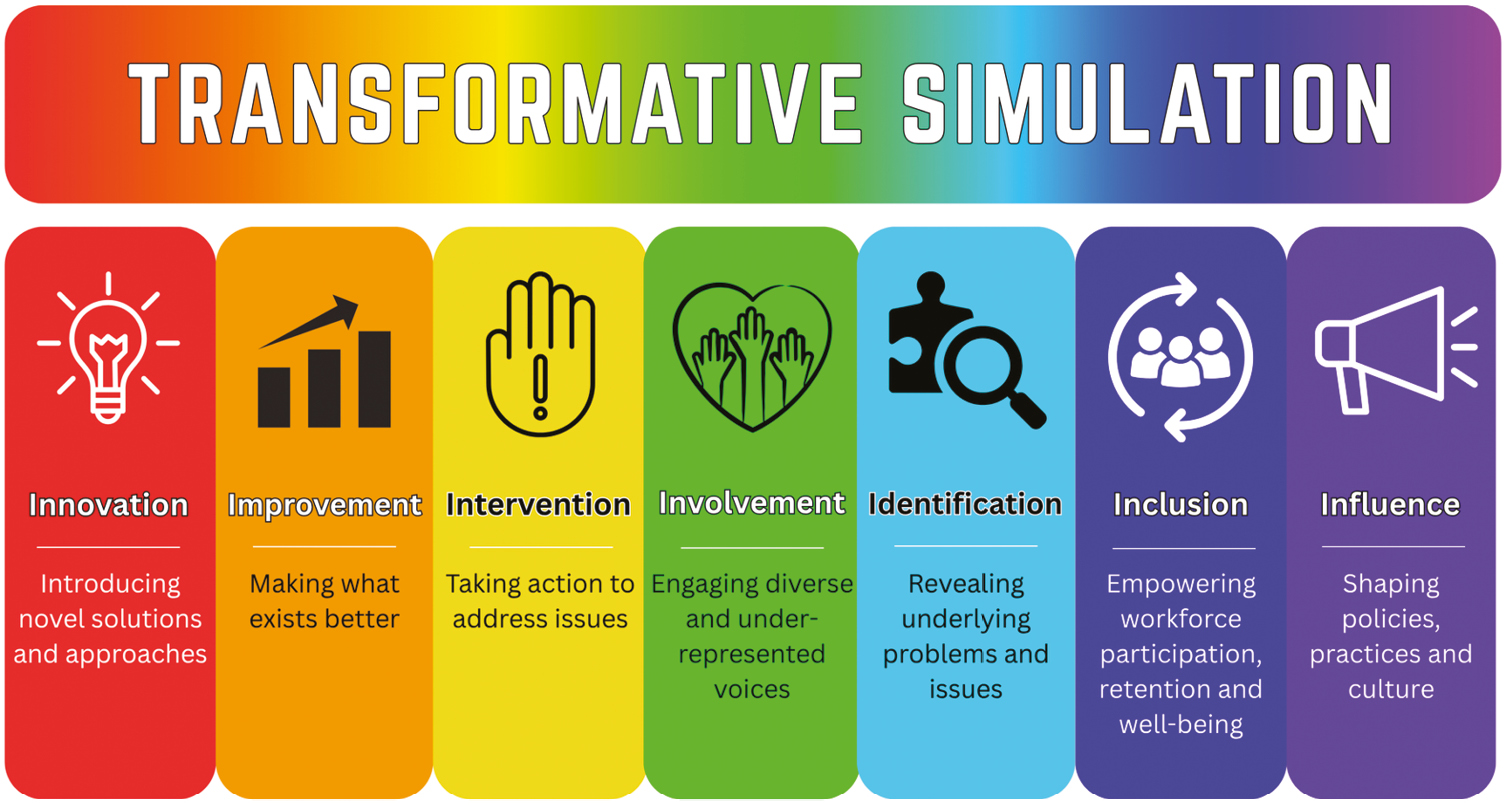
Transformative Simulation seven simulation-based intentions taxonomy descriptors [39]
Seen in this light, Transformative Simulation does not replace educational simulation, nor does it diminish its value. Instead, it clarifies that simulation can serve multiple purposes, each requiring different forms of design, facilitation and data capture [5]. By distinguishing ‘simulation to educate’ from ‘simulation to transform’, Transformative Simulation provides a coherent framework for aligning intention, method and outcome – ensuring that simulation is used not only to improve performance within existing systems but also to support the collective insight and learning required to change those systems themselves.
The work described in this essay largely predates the introduction of the term translational simulation and therefore reflects an independent trajectory in the evolution of simulation design. While Transformative Simulation shares with translational simulation an interest in extending simulation beyond education to support improvements in healthcare, it was subsequently developed as a purpose-led framework organised around multiple simulation intentions across improvement and cultural and systems transformation. The relationship between these approaches is explored in greater detail elsewhere [5,42] and is not the primary focus of this historical reflection.
The evolution of healthcare simulation has been shaped not only by advances in technology, but by sustained design experimentation that challenges deeply held assumptions about fidelity, realism and performance. Through the development of hybrid, distributed and sequential simulation, simulation is being progressively freed from static environments, single episodes and clinician-centred viewpoints. Deliberate movement between circles of focus has enabled attention to shift – from task to interaction, from interaction to system and ultimately from isolated performance to lived trajectories of care.
These experiments revealed that realism is not achieved through completeness or replication, but through intentional selection. By relinquishing the demand for perfection and suspending predetermined measures, simulation can create conditions in which the messy realities of healthcare are encountered rather than obscured. Imperfection becomes a methodological strength, allowing work-as-done to surface alongside work-as-imagined. In doing so, simulation makes visible forms of knowledge – emotional labour, moral tension, adaptive workarounds and boundary negotiations – that remain largely inaccessible to conventional metrics, yet are central to how healthcare systems actually function.
As simulation increasingly brought together clinicians, managers, patients and publics, its capacity to support reciprocal illumination has become apparent [41,43]. In complex systems where no single actor holds the full picture, shared representations allowed partial perspectives to be surfaced, aligned and collectively examined. The patient journey, experienced longitudinally rather than episodically, has emerged as a powerful organising lens – revealing how local actions accumulate across time and how fragmentation is felt in practice. Through this shared engagement, mental models are not imposed but formed in real time, enabling change to be co-authored rather than prescribed.
It is through these insights that the distinction between simulation used to educate and simulation used to transform becomes clear. While educational simulation remains vital for developing competence and confidence, simulation for transformation operates according to a different logic – one oriented towards emergence, collective sensemaking and system learning, as demonstrated across subsequent Transformative Simulation studies and examples [27–36,39,41]. Transformative Simulation formalises this distinction, offering a framework in which intention guides design without constraining discovery and where simulation serves as a space for inquiry rather than instruction.
This reflection is not intended to suggest that Transformative Simulation supersedes other approaches to simulation, nor that it is appropriate in every context. Educational simulation remains essential where the primary purpose is the development or assessment of individual and team capability, particularly where procedural expertise, technical precision or high-risk performance are central. Likewise, fidelity should always be determined by purpose rather than ideology. Transformative Simulation emerged not from a rejection of existing approaches, but from the recognition that certain organisational and systems-level challenges required a different organising framework. As with any approach, its value depends on thoughtful design, appropriate facilitation and a clear alignment between purpose, context and method [42].
Ultimately, healthcare does not lack intelligence. It lacks shared space and time to think, feel and reimagine together. When designed with intention, openness to imperfection and sensitivity to perspective, simulation provides such a space – supporting not only learning within systems but also the collective insight required to change them.
The authors gratefully acknowledge the many patients, members of the public, simulated participants, healthcare professionals, educators, researchers and organisational partners nationally and internationally who contributed to the simulation design work described in this essay over more than two decades. We particularly acknowledge the support of our NHS collaborators, Imperial College London, the Imperial Centre for Engagement and Simulation Science (ICCESS), the University of Greenwich and the Association for Simulated Practice in Healthcare (ASPiH), whose environments, partnerships and communities have helped shape the ideas that ultimately informed the development of Transformative Simulation.
SMW and RK contributed to the conceptualisation of the manuscript and to the body of simulation work and conceptual development on which the paper draws. SMW led the synthesis, development and drafting of the manuscript. RK contributed to the interpretation and framing of the concepts and critically revised the manuscript for important intellectual content. Both authors reviewed and approved the final manuscript.
The programme of work described in this essay has been supported over more than two decades through a combination of research, innovation and service improvement funding. The authors gratefully acknowledge the support of the Wellcome Trust, the Arts and Humanities Research Council (AHRC), the Engineering and Physical Sciences Research Council (EPSRC), the Economic and Social Research Council (ESRC), Health Education North West London, the London Deanery Simulation and Technology-enhanced Learning Initiative (STeLI), the North West London Integrated Care Pilot, Hounslow Clinical Commissioning Group, Hammersmith and Fulham Clinical Commissioning Group, Imperial College London, the University of Greenwich and other collaborating NHS organisations whose support enabled the development, refinement and evaluation of the simulation approaches described in this essay.
None declared.
None declared.
Sharon Marie Weldon is President of the Association for Simulated Practice in Healthcare (ASPiH) and co-leads the Transformative Simulation Special Interest Group (SIG).
1.
2.
3.
4.
5.
6.
7.
8.
9.
10.
11.
12.
13.
14.
15.
16.
17.
18.
19.
20.
21.
22.
23.
24.
25.
26.
27.
28.
29.
30.
31.
32.
33.
34.
35.
36.
37.
38.
39.
40.
41.
42.
43.
 Insights from Transformative Simulation over time: from replication to collective inquiry
 Facebook
 Twitter
 Linkedin
 Whatsapp
