


Clinical simulation is a key part of clinician learning and team training in the aeromedical and retrieval setting. We have described a technique utilizing Microsoft PowerPoint® (Microsoft Corporation) to create interactive simulation resources to allow small-team training in the absence of a facilitator. We provide a practical discussion of the rationale, process and anticipated benefits of this resource, which could translate into numerous other areas of clinical medicine in a cost-effective and easily reproducible format.
What this essay adds:
•Description of a novel but low-cost technique using Microsoft PowerPoint® (Microsoft Corporation) to act as a facilitator for simulation training.
•Practical explanation of the process to allow others to utilize similar techniques.
Simulation has long been recognized as a cornerstone of medical education [1] and is used regularly as a training tool in aeromedical and retrieval medicine, aiming to form effective and high-performing teams. High-fidelity manikins, bespoke simulation centres and dedicated faculty can deliver excellent training, but they also come with significant financial, logistical and staffing requirements. For many organizations, particularly retrieval services with decentralized staffing due to dispersed geographical service provision, these barriers can limit the frequency and accessibility of simulation-based education. In response to this challenge, we developed a series of interactive clinical simulations using Microsoft PowerPoint®: a low-cost, reproducible and highly adaptable approach that allows small teams of clinicians to practise independently while still achieving meaningful educational and practical CRM objectives.
Following an internal needs analysis survey of retrieval clinicians, it was identified that there were several barriers to participation in simulation training. These included a lack of local physical resources, attitudinal differences towards daily simulation training among established staff and a lack of feedback availability.
As a result of these outcomes, the authors attempted to address the identified barriers by developing a resource to mitigate these shortfalls. Simulation in our setting often takes place with a small team of two clinicians (retrieval doctor and flight nurse or paramedic), often without a facilitator present to control case progression, provide clinical data or debrief the scenario.
Our aim was to design a simulation format that could be run independently by these two clinicians, with a low-fidelity, intubatable mannequin, facilitated by the PowerPoint® resource, providing the opportunity for deliberate practice of technical and non-technical skills in a novel clinical situation.
PowerPoint® was selected as the core platform because it is ubiquitous, familiar to most clinicians and available within many existing organizational software licences. Importantly, it allows for the creation of interactive content using hyperlinks, animations, audio and visual media. This makes it possible to replicate key elements of dynamic patient condition changes, without the need for specialist simulation software or hardware.
Each scenario is built around a specific clinical case. Instructions and photographs of how the mannequin appears at the start are provided to allow setup of the simulation, with photographs to set the scene (e.g. a crash on a rural road), as well as to demonstrate any equipment that may already be in position for the scenario, such as cervical spine immobilization [Figure 1].

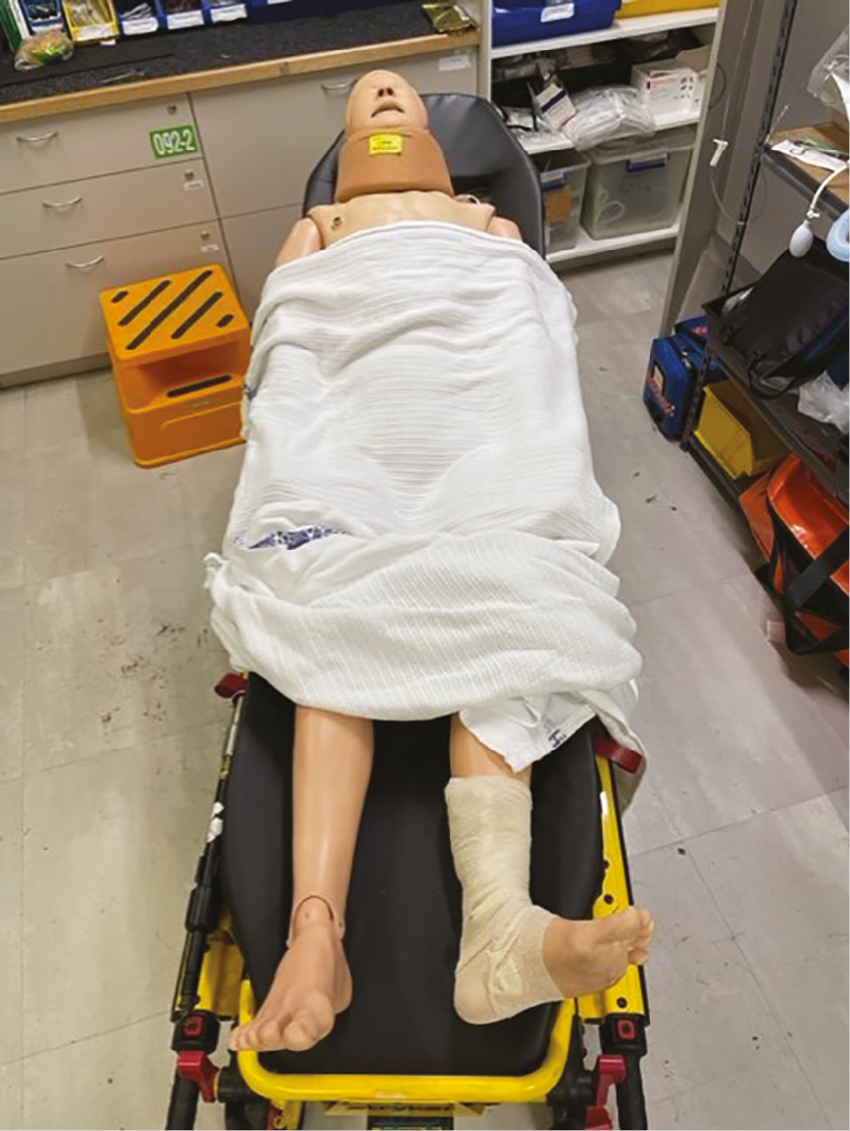
Example image of mannequin setup
Various multimedia sources are provided, using automated settings in the PowerPoint® programme to deliver these, such as voice recordings of a patient handover or photographs of a wound, which increase realism and reduce the burden of reading large amounts of text.
Dependent on the clinical events in the various scenarios, automated settings may move the scenario forward, but at other times participants are instructed to move the scenario on following completion of a specific task, such as after completing a discussion of their plan for the patient after handover.
Photograph images of the retrieval equipment utilized by our service appear on the slides that provide the patient observations, with the aim of increasing familiarity with equipment items [Figure 2]. Other techniques to enhance realism involve utilizing the same alarm tones on standard equipment used by the service to signal patient deterioration and allow the team to respond. There are several helpful tools available within Microsoft PowerPoint® which can contribute to engagement, such as utilizing animated shapes as countdown bars to indicate when the scenario will automatically progress, both to instil a sense of time urgency which exists in the real retrieval or pre-hospital environment, as well as to ensure the scenario moves forward in a timely fashion.
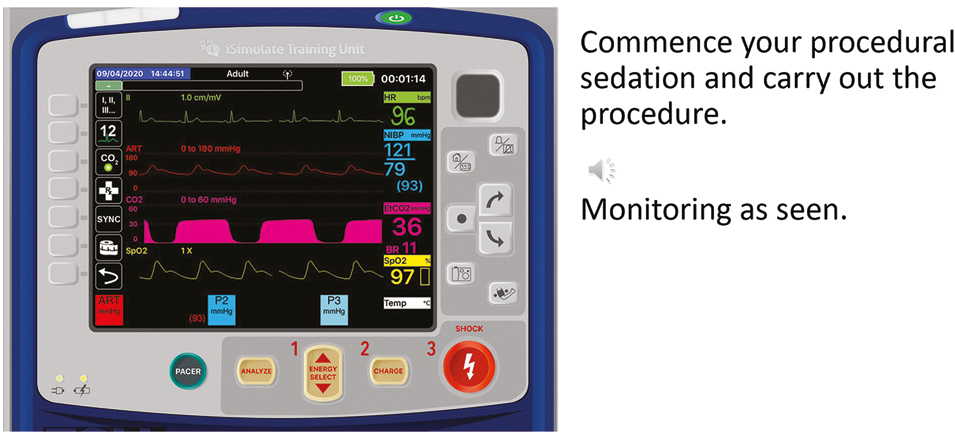
Screenshot from the case with information provided to participants
They were trialled with new and experienced staff with adjustments and feedback. The authors’ contact details were provided in the introductory document. Changes to scenarios are made in alignment with feedback received and organizational workflow changes. This process has allowed a series of guided simulation resources to be created, which allow for deliberate practice [2] using essential equipment such as femoral traction splints, the performance of critical procedures such as rapid sequence induction and the addition of complexity modifiers to a case, such as caring for paediatric or bariatric patients or unexpected haemodynamic instability. Whilst procedural competence was one goal, another perceived benefit of these scenarios was the ability to build teamwork and communication skills within the group, allowing translation of skills and strategies into real cases. It also provides the opportunity for the team to ‘handover’ their patient at the end of the case, mimicking real-world workflow for aeromedical and retrieval clinicians. The ease of accessibility of these resources lends itself to opportunistic utilization, such as in quieter periods of a shift.
Provision of feedback is one challenge we encountered during the creation of these cases. There is no true substitute for an external observer who can provide feedback both on the clinical care delivered as well as communication and teamwork attributes. To tackle this barrier, we utilized an audio file with some specific clinical advice from a Retrieval Medical Coordinator (MC) after the team has provided a situation report (SITREP) about their patient, to ensure the team stays on track with the anticipated clinical management. Again, this mimics real-world workflow, where the MC is responsible for asset tasking and clinical oversight for the duration of the retrieval. A final slide is provided summarizing the key patient issues, intended management points, along with links to relevant Standard Operating Procedures (SOPs) to encourage further revision.
Debriefing is a further difficulty when utilizing PowerPoint® as the case facilitation method. To address this, we created a ‘self-debrief’ model which is based on a recognized facilitated debriefing model, the Diamond Debrief [3]. This was selected due to the authors’ knowledge and familiarity, and ease of use in the absence of a facilitator. The model is introduced at the outset, before any scenarios are selected, to ensure participants understand how they are to engage in the team debriefing sequence after the completion of the clinical scenario. The debrief has structured questions that guide participants through a review of the case, with the aim of assisting learning and incorporating these learning points to improve patient care which might be provided subsequently in a real case.
Over time, a library of simulation resources has been generated for use in daily training, providing varied and relevant practice opportunities for teams. This resource is shared across the multiple bases within our aeromedical organization which also supports standardization of practice, as all cases reference organization-wide SOPs. This cost-effective, sustainable and easily scaled method of ‘unfacilitated’ simulation may be relevant for other organizations to adapt to their own environment, requiring minimal training material and not requiring a facilitator. Once these resources have been created, minimal ongoing staffing outlay is required to maintain their currency. Other equipment required includes basic audio recording equipment, access to PowerPoint® software and a device to play these resources, such as a tablet or laptop. These can be combined with existing mannequins and training equipment already available to clinicians.
Hands-on practice with mannequins, clinician-observed feedback and facilitated debriefing remain essential components of comprehensive training programmes. The proposed simulation resources are not intended as a substitute for this; rather, they are an accessible and effective adjunct. PowerPoint®-based simulations are particularly useful for the frequent practice of decision-making and teamwork in novel clinical situations. In a healthcare environment where efficiency, scalability and staff buy-in are increasingly important, simple tools used creatively can deliver powerful educational outcomes.
None declared.
None declared.
None declared.
None declared.
None declared.
1.
2.
3.
 A low-cost, high-yield learning solution for aeromedical and retrieval team training
 Facebook
 Twitter
 Linkedin
 Whatsapp
